
Where are all the Green and Purple Stars?
Reading Time: mins
If stars can shine across every colour of the rainbow, then why have we never seen a green or a purple star in the night sky?
When you look up on a clear night, you’ll see stars in shades of blue, red, and white but never green or purple. The truth is, stars do produce green and violet light, but the way starlight travels to us and the way we see it, changes what we actually perceive.
The Biology of Our Eyes
The first step to understanding this begins inside our own eyes. The way that we see colour is not as simple as it seems. Your eyes don’t actually “see” every individual colour. Instead, our eyes rely on just three types of special cells in the retina called cones. These cones work together like tiny sensors, each tuned to a different range of colours. When light from a star hits your eye, all three cones send signals to your brain, which then mixes those colours to decide which colour you’re seeing.
- S-cones respond to short wavelengths — blue and violet light.
- M-cones respond to medium wavelengths — green light.
- L-cones respond to long wavelengths — red light.
Every colour we see is created by our brain combining signals from these three cones — just like mixing red, green, and blue lights on a stage to make many different colours.
But, here is where it gets interesting — there is no purple cone! When violet light enters your eye, it mostly activates your blue cones and only slightly triggers the red ones. Your brain combines those signals and decides that you’re seeing something closer to blue than to pure violet. Also, our eyes are least sensitive to violet light, so we see it as weaker than it really is.
This means that even if a star is emitting lots of violet light, your eyes interpret that signal as something closer to blue.
Earth’s Atmosphere
Our eyes aren’t the only thing changing what we see — the Earth’s atmosphere also plays a big role. You can think of the atmosphere as a filter that starlight has to pass through before it reaches us. As that light travels through the air, the shorter wavelengths (violet and blue) get scattered more easily than longer wavelengths (red and orange). This process is called Rayleigh scattering (see The Many Faces of the Moon, and it’s the very reason the sky is blue during the day.
Violet light actually scatters even more strongly than blue, so why then do we not have a violet sky during the day? Much of the violet and ultraviolet light is absorbed by the ozone layer in the upper atmosphere. Ozone molecules are very good at absorbing high-energy light, stopping most UV and some violet from reaching the ground. This means the light that finally reaches the ground has more blue than violet, which is why the sky appears blue.
The same effect happens with starlight. Light from very hot stars contains a lot of violet, but by the time it passes through our atmosphere, much of that violet has been scattered away or absorbed. What reaches our eyes contains more blue, so even the hottest stars appear blue-white instead of purple.
Types of Star Colours Across the Spectrum
Take a moment to really look at the stars on a clear night and you might notice something surprising — they’re not all the same colour! Some glow with a warm orange tint, others shine icy blue-white, and plenty look bright white or yellow. These colours aren’t random — they reveal the star’s temperature.
Astronomers sort stars by spectral type, which is just a way of arranging them from the coolest to the hottest and seeing how their colour changes:
- Red stars – These are the coolest stars, with surface temperatures below about 3,500 °C. They glow with a faint red-orange light. Most stars in our galaxy are actually red dwarfs — small, dim stars that live for an incredibly long time. Our closest stellar neighbour, Proxima Centauri, is a red dwarf just 4.2 light-years away!
- Orange and yellow stars – Slightly hotter than red stars, these include stars like our own Sun. The Sun’s surface is about 5,500 °C, which makes it look white from space but a little yellow from Earth. Another famous yellow star is Alpha Centauri A, which is just over 4 light-years away — making it the closest Sun-like star to us.
- White stars – Hotter still, with surface temperatures between 7,000 and 10,000 °C. These stars emit a balanced mix of colours, so they look dazzlingly white. Sirius, the brightest star you can see in the night sky, is a great example and only 8.6 light-years away.
- Blue stars – These are the hottest of all, burning at 20,000 °C or more. They use up their fuel quickly and shine with a brilliant blue-white light. Rigel, the bright star at the foot of Orion, is a blue supergiant — a huge, powerful star nearing the end of its life. Even though it’s around 860 light-years away, it’s still one of the brightest stars we see.
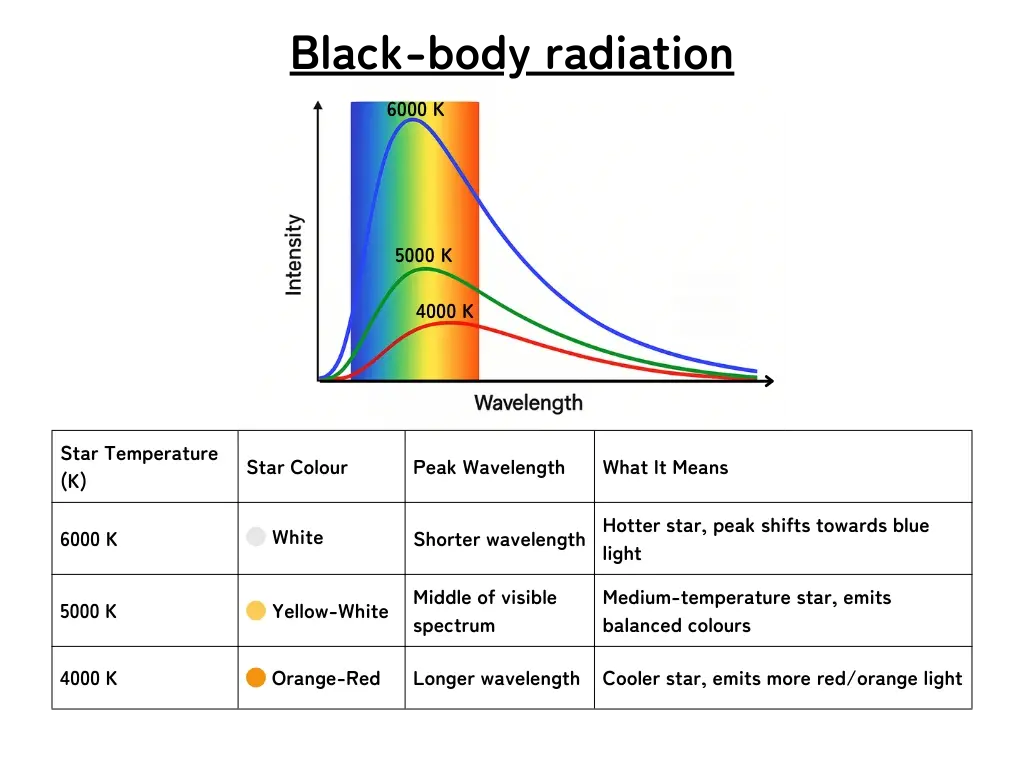
It might seem strange, but in astronomy blue means hottest and red means coolest — the opposite of what we think of with things like taps or fire. This is because hotter stars glow with shorter-wavelength light (blue), while cooler stars glow with longer-wavelength light (red).
You might wonder why there’s still no green star on the list — that mystery is solved when we look at how all the colours a star emits combine.
Colour Mixing and Star Light
Here’s the biggest reason you don’t see green stars: stars don’t shine in just one pure colour.
Stars are what physicists call blackbody radiators — they glow across a wide range of wavelengths, from red through green and blue all the way to violet. The hotter the star, the more its peak shifts towards blue/violet, but there is always a full spread of colours being emitted.
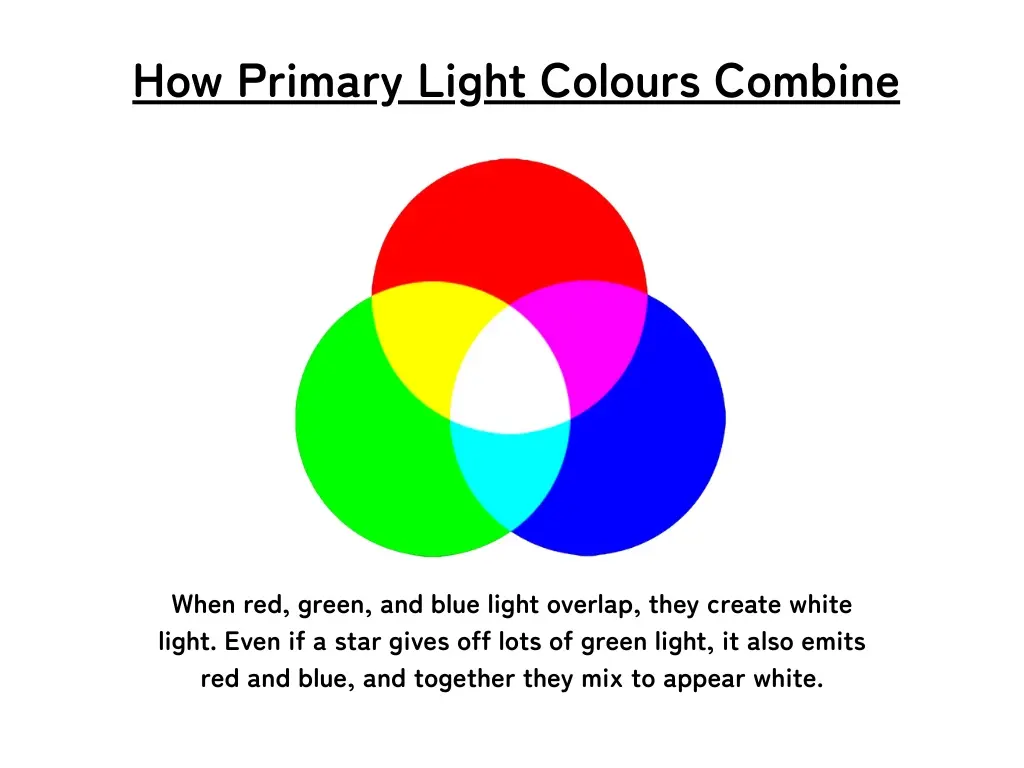
If a star gives off a lot of green light, it’s also giving off plenty of red and blue. When these colours hit your eye together, they blend into white (or white with a slight blue or yellow tint). It’s like mixing different coloured paints together — add red, green, and blue paint, and the result is a single blended colour rather than seeing green on its own.
So, a “green star” isn’t missing from the universe — it just looks white to us because its green light is mixed with all the other colours.
Is the Sun Actually Green?
Here’s a surprising fact: the Sun actually emits most of its light in the green part of the spectrum! If you graphed the intensity of its light against wavelength, the curve would peak right around green. But because the Sun also gives off every other colour of visible light, those colours blend together to appear white.
From Earth’s surface, sunlight often looks slightly yellow because the atmosphere scatters some of the blue light away — especially at sunrise and sunset when the Sun is low in the sky.
Did You Know this about stars?
- Blue stars are the hottest of all, blazing with blue-white light.
- Red dwarfs are the coolest stars, glowing a deep orange-red.
- There are no naturally pink or purple stars — those colours in space photos usually come from glowing nebulae or from filters used by telescopes.
Conclusion
So now we know the answer to why we don’t see green and purple stars — it’s our biology and Earth’s atmosphere that filter those colours away. Stars give off every colour at once, which mixes into white, and our eyes and atmosphere make what remains appear blue or white.