
Quantum Tunnelling and Nuclear Fusion: How Stars Shine in the Universe
Reading Time: mins
How Quantum Tunnelling Enables Nuclear Fusion in Stars
What would you think if you were told that the Sun shouldn’t exist according to the rules of physics? It might sound impossible, but the mechanics that keep it shining challenge the limits of what we think is possible. The universe has ways of working that go against our intuition and break the classical laws that we’re familiar with. Somewhere in these cosmic loopholes lies the secret that allows stars to exist—and it’s a story stranger than you might imagine!
The Role of Quantum Tunnelling in Stellar Fusion and Energy Production
Stars are the engines of the cosmos, providing the energy needed to form planets, create heavier elements, and support the conditions required for life. Without stars, there would be no light, heat, or fusion to create the elements essential for planets and biological systems, and no gravitational forces to bring matter together. The universe would be just a scattered cloud of gas and dust with no stars, planets, or galaxies.
Yet stars do exist, but the question is: how? Classical physics says that the nuclear fusion process which fuels stars simply shouldn’t be possible. The powerful repulsive forces between positively charged particles in a star’s core should prevent them from ever fusing. However, the universe has a surprising answer—a phenomenon known as quantum tunnelling.
This intriguing process allows particles to leap past barriers they shouldn’t be able to cross, defying the rules of classical physics and making stars possible.

Quantum Tunnelling in Particle Physics: Wave-Particle Duality Explained
At first glance, the rules of quantum mechanics seem to belong to a completely different universe—one where particles behave more like waves than tiny solid balls. This wave-like behaviour is the key to understanding quantum tunnelling, a phenomenon that might sound like science fiction but is, in fact, very real.
To explain this, we can use a simple analogy. Imagine that you’re playing a challenging video game, and your character is faced with a massive wall blocking the way forward. Normally, you’d need to find a way to jump or climb over it. But instead, your character suddenly glitches and appears on the other side. This is similar to how quantum tunnelling works—particles bypass barriers they shouldn’t be able to cross, as if they’ve found a loophole in the laws of physics.
This isn’t magic—it’s quantum mechanics at work. Particles like protons and electrons don’t behave like solid objects with fixed positions. Instead, their behaviour is governed by a wave function, which predicts the probability of where they might be. If this wave function extends beyond a barrier, there’s a chance the particle will tunnel through it, appearing on the other side without ever crossing the barrier in the classical sense.
Quantum tunnelling is a fascinating phenomenon of the quantum world. Its ability to allow particles to defy classical rules reveals the strange yet fundamental nature of quantum mechanics.
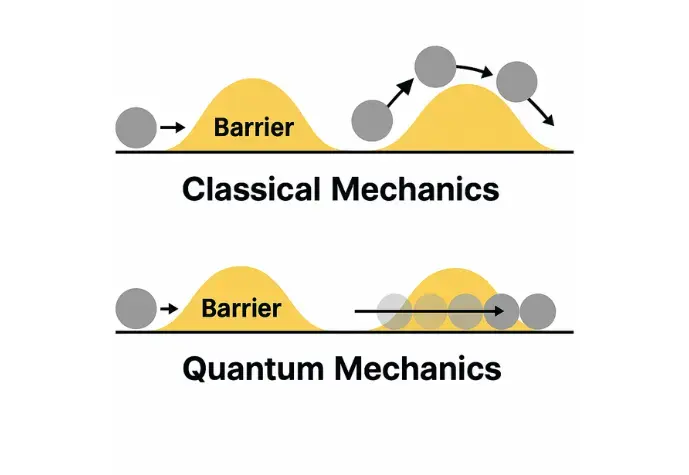
Quantum Tunnelling in Nuclear Fusion: The Physics Behind How Stars Shine
Inside the core of a star like our Sun, conditions are extreme. Temperatures reach millions of degrees, and the pressure forces tiny particles like protons (the positively charged nuclei of hydrogen atoms) into close proximity. However, protons naturally repel each other due to their positive charges, creating a strong barrier that should prevent them from fusing. According to classical physics, nuclear fusion (the process that powers stars) shouldn’t be possible.
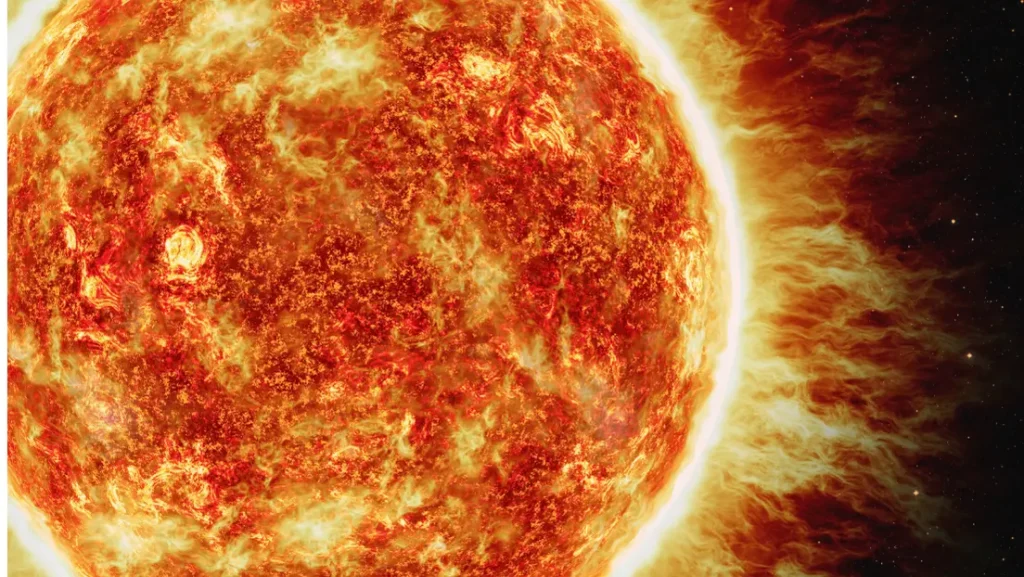
This is where quantum tunnelling changes everything. Despite the repulsive forces, protons in a star’s core behave like waves rather than solid objects. This wave-like nature allows a small but significant probability for protons to tunnel through the energy barrier and fuse together. When this happens, protons merge to form helium, releasing enormous amounts of energy in the form of light and heat.
This energy is what powers the Sun and, by extension, life on Earth. The warmth and light we experience every day come from countless quantum tunnelling events occurring in the Sun’s core every second. Without it, stars couldn’t shine, and the universe would be a cold, dark, and lifeless place.
By connecting the quantum world to the immense processes within stars, quantum tunnelling shows how phenomena at the smallest scales have universe-sized consequences.
Quantum Effects in White Dwarfs and Neutron Stars: The Role of Tunnelling
Quantum tunnelling is widely recognised for its role in powering stars like the Sun, but it also plays a significant role in the later stages of a star’s life. After a star uses up its nuclear fuel, it may collapse into a white dwarf or, if it’s massive enough, into a neutron star. These stellar remnants are among the densest objects in the universe, where quantum effects become even more critical.
In white dwarfs, gravity exerts immense pressure, forcing electrons into extremely confined spaces. Quantum tunnelling enables these electrons to overcome their natural repulsion, helping to maintain the stability of the white dwarf. Without this quantum effect, the white dwarf’s structure would give way, leading to further collapse under its own gravitational force.
The conditions in neutron stars are even more extreme. The density is so high that protons and electrons are compressed into neutrons. Here, tunnelling allows particles to rearrange during this process, stabilising the star in its incredibly dense neutron-rich form. This phenomenon prevents the neutron star from collapsing into a black hole (unless it exceeds a specific mass threshold).
Quantum Tunnelling in Modern Technology and Fundamental Physics
So far, we’ve determined that without the quantum leap of particles, the Sun and every other star in the universe wouldn’t exist.
But its importance doesn’t stop there. This same phenomenon plays a critical role in modern technology. Take the scanning tunnelling microscope (STM), for example. This remarkable device uses quantum tunnelling to image individual atoms, giving scientists the ability to study matter at the smallest of scales. The STM has transformed fields like nanotechnology and materials science, opening the door to innovations in everything from medicine to renewable energy.
This phenomenon is used in many electronic devices, particularly in the downsizing of transistors which power the smartphones, laptops, and other gadgets we use every day. As engineers work to make technology smaller and faster, they must account for the tunnelling effects of electrons in microscopic circuits.
The Future of Quantum Tunnelling in Space, Energy, and Computing
Quantum tunnelling is just one of many strange and fascinating phenomena that demonstrate how the universe operates on the smallest of scales. Without it, the universe would be a cold, dark expanse; yet here we are, powered by the energy of countless stars, all made possible by the unique principles of quantum mechanics. The more we learn, the more questions come up. If particles can tunnel through obstacles, what other “impossible” phenomena might they accomplish?
Could this understanding lead to new breakthroughs in energy, space exploration, or even computing? The quantum world continues to challenge our understanding, showing us that the universe operates in ways that defy intuition yet create incredible possibilities.
As you look up at the night sky, take a moment to consider this: every star owes its light to a phenomenon so small that it lies outside the limits of human perception.
Blog written by Laura Ash for Mission Astro.
Image used in excerpt: Neutron star https://flickr.com/photos/53460575@N03/26194729776