
How Earth Creates the Colours of the Aurora
Reading Time: mins
Introduction
The northern lights come in waves of green, flashes of red and occasional hints of purple. But what controls these colours, and why do they appear at different heights in the sky? To uncover that, we need to look far above Earth’s surface, where incoming energy from space interacts with our atmosphere in surprising ways.
How Atoms Produce Light
The colour of the aurora begins with collisions. Energetic particles arriving from space hit atoms and molecules in Earth’s atmosphere, giving them extra energy. A way to picture this is to think about popcorn in a microwave. All the kernels heat up in the same environment, but each one pops in its own way because of its structure. Atoms behave in a similar way: when they absorb energy from a collision, they release it again as light, and the colour depends on the type of atom involved. Because each element has its own arrangement of electrons, the colours it produces are very specific.
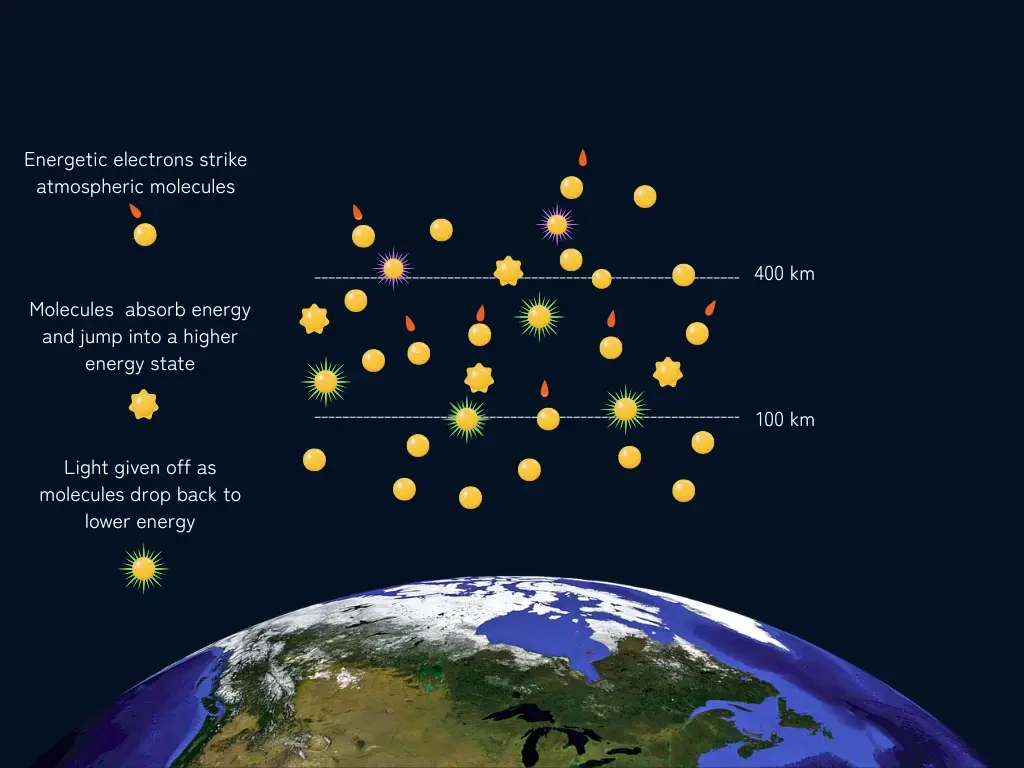
Energetic electrons collide with atmospheric atoms at different heights; as these atoms lose energy, they release coloured light.
Oxygen’s Colours: Greens and High-Altitude Reds
Green is the colour most people associate with the aurora, but what makes it appear so often? Much of it comes down to how oxygen behaves high above Earth. At around 100–150 km, the air is thin enough for oxygen atoms to release a bright green light without being interrupted by too many collisions.
Higher still, in an even thinner region of the atmosphere, oxygen can produce a deep red glow instead. This red emission takes longer to form, so it only appears where collisions are rare. During stronger auroral events, the upper red layer can become bright enough to be seen clearly from the ground.
Nitrogen’s Colours: Purples, Blues and Pinks
Nitrogen behaves a little differently. When nitrogen molecules become energised, they return to their normal state very quickly, releasing blue or purple light. These colours tend to appear at lower altitudes than oxygen’s green because nitrogen is more common deeper in the atmosphere.
When blue or purple nitrogen emissions combine with red oxygen light, the result can be pink or magenta. This blending of colours happens where the two emission regions overlap.
Altitude: The Colour Ladder of the Aurora
The atmosphere acts almost like a series of stacked layers, and each type of emission fits into a particular band. At the top, where the air is extremely thin, red oxygen emissions dominate. Further down, where the atmosphere is ideal for oxygen to produce green emissions, the well-known green glow appears. Near the lower end of the aurora, nitrogen is the main contributor, producing blue and purple.
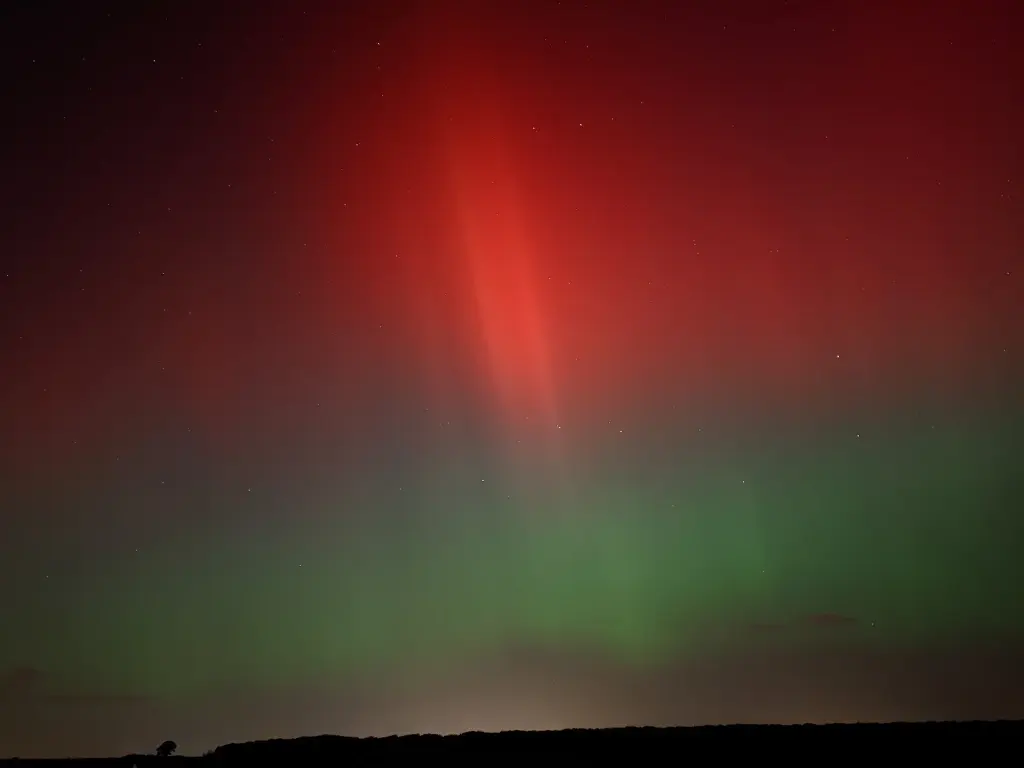
This arrangement means that the vertical structure of the aurora often shows a predictable order of colours: reds highest, greens in the centre, blues and purples nearer to the bottom.
Why Auroras Change Shape and Brightness
Auroras rarely stay still. Their constantly shifting appearance reflects how quickly conditions can change high above the ground. The familiar ripples, curtains and pulses form because the amount of energy entering the atmosphere is always changing. When that energy increases, the colours brighten; when it reduces, the aurora fades.
The overall shape of the lights follows Earth’s magnetic field, which guides incoming particles along curved paths. Changes in density, temperature or the flow of energy can make parts of the aurora brighten or move, creating the patterns that make auroras so striking.
Why Eyes and Cameras See Different Colours
Human eyes struggle with colour in the dark. At night, our vision relies heavily on rod cells, which detect brightness but not colour very effectively. This means faint auroras often appear greyish or pale when viewed without a camera.
A camera sensor, especially in long-exposure mode, collects more light than our eyes can in a single moment. This allows cameras to show reds, violets and other faint colours that may be present but not easily visible. The colours in the photographs are genuine — the camera simply records them more efficiently than the human eye. You can read more about the role of the eye in detecting colours here.
Rare Aurora Colours and How They Form
Although green, red, blue and purple are the main aurora colours, others sometimes appear under unusual conditions. A strong burst of energy can make high-altitude oxygen glow a vivid crimson. Under the right overlap of emissions, turquoise or yellow can appear, though these are uncommon. Such colours usually happen when multiple emission lines blend or when specific atmospheric conditions allow weaker colours to stand out more clearly.
The Southern Lights: Earth’s Other Aurora
While the northern lights attract most of the attention, the same physics also creates the Aurora Australis in the southern hemisphere. Here, energised particles follow Earth’s magnetic field towards the south magnetic pole, producing the same range of colours seen in the north.
Some events in the southern hemisphere can even be stronger than those in the north. This is partly because Antarctica sits closer to the south magnetic pole, giving the auroral oval a more centred and symmetrical shape.
The reason the southern lights are less well known is simply because of geography — far fewer people live at the right latitudes to witness them. However, places such as Tasmania, southern New Zealand and parts of southern Australia regularly experience remarkable displays during active periods. Although the Aurora Australis is photographed less often, it can be every bit as vivid and varied as its northern counterpart.
Conclusion
Every aurora display is shaped by the atoms in Earth’s atmosphere and the conditions around them. The colours we see depend on altitude and the behaviour of oxygen and nitrogen high above the ground. When the sky glows, we’re watching the upper atmosphere respond to energy arriving from space, and the balance of these processes shifts from one event to the next. This is what makes each aurora unique while still following the same set of physical principles every single time.
Fun Facts About Auroras
- Astronauts see auroras very differently from people on the ground. From orbit, the lights appear as curved glowing bands wrapped around Earth, following the shape of the magnetic field. This view makes it clear that auroras form a complete ring around each pole rather than a patch of sky in one direction.
- Red auroras have caused confusion throughout history. Before the science was understood, people sometimes interpreted deep red glows as distant fires or signs of danger because they can stretch across huge areas of the sky. These events are rare but can be seen during stronger auroral activity when high-altitude oxygen becomes especially bright.
- Strong auroras can also affect technology. When energetic particles disturb the ionosphere, GPS signals may become less accurate and radio communication can weaken or cut out entirely. These effects remind us that auroras are not only beautiful displays but also part of the space weather systems that influence Earth.
This blog was written by Laura Ash for Mission Astro