
The Universe Has Its Own Clock: Pulsars and Time
Reading Time: mins
Imagine waking up in a world with no clocks. No phone alarms, no reminders, no simple way to tell when lessons end or how long you’ve been scrolling. Everything would feel unpredictable. Now picture being an astronomer. In space there are no days or nights, no school bells, just endless darkness. So how do scientists tell time out there? Surprisingly, they turn to collapsed stars that spin with incredible precision. These remarkable objects, called pulsars, act like clocks built into the universe itself.
A pulsar’s rotation can be so steady that some are even more reliable than the atomic clocks used on Earth. These cosmic timekeepers were born after one of the most dramatic events in the universe: a supernova. Even though the explosion is chaotic, what remains becomes one of the most stable objects known to science. Dr Heather Campbell explains how Supernovae are discovered here.
What Is a Supernova?
A supernova marks the final moments in the life of a massive star. When a star several times heavier than our Sun runs out of fuel, it can no longer support itself. Its core collapses while its outer layers blast into space at incredible speed. For a short time, the explosion can shine brighter than a whole galaxy! The force of the blast creates many of the heavier elements found in the Periodic Table, like nickel, gold, silver, and uranium.
Deep within the expanding cloud of glowing gas, the core is squeezed into something unbelievably dense. A mass equal to our Sun, large enough to hold more than a million Earths, is crushed into a sphere only about 20 kilometres wide! That tiny object is called a neutron star. And if it spins and sends beams of radiation into space, it is a pulsar.
So What Exactly Is a Pulsar?
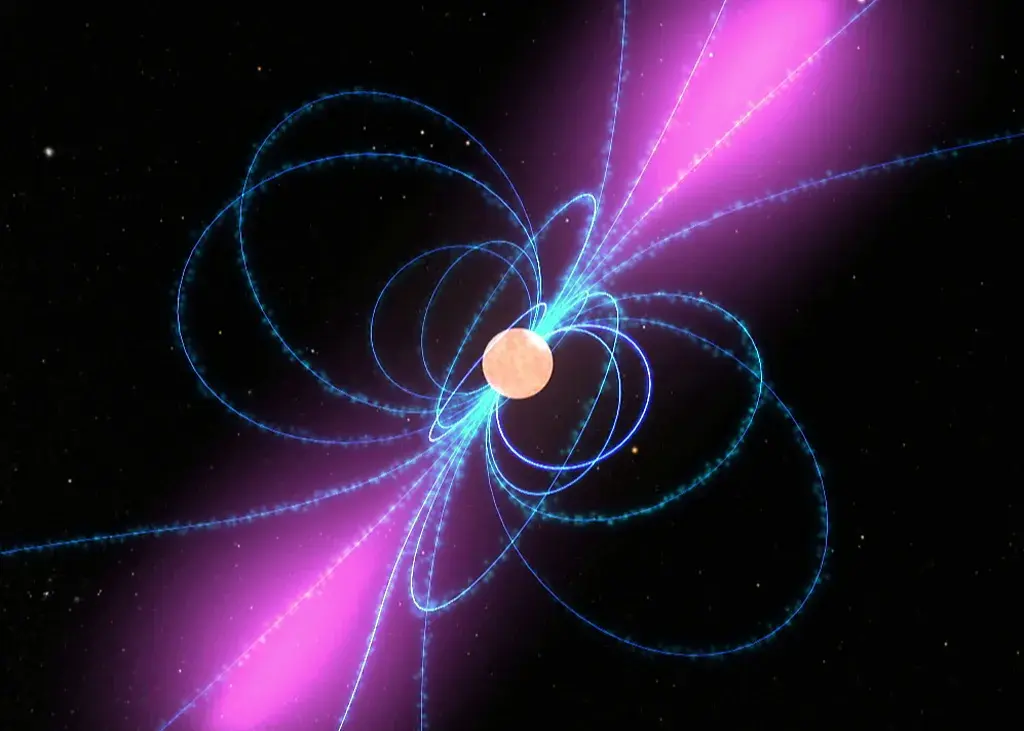
A pulsar is a rapidly spinning neutron star, a small but extremely dense remnant left behind after a supernova. Although only the size of a city, it contains more mass than the Sun. Because of the forces involved in the explosion, this newly formed object spins at extraordinary speeds, sometimes turning hundreds of times per second.
As it rotates, the pulsar’s strong magnetic poles produce narrow beams of radiation. Imagine a lighthouse sweeping its beam across the sea. Each time the beam points toward Earth, we detect a pulse. That regular, rhythmic flashing is what gives pulsars their name: pulsating stars.
How Pulsars and Time are Connected
Pulsars are fascinating because their spin is so predictable. Some change by only a few millionths of a second over many years. Their reliability makes them some of the best natural clocks in the universe.
When pulsars were first discovered in 1967, their perfect rhythm confused astronomers so much that they briefly wondered whether the signals were artificial. The very first one was even named LGM-1, short for “Little Green Men 1”. It wasn’t aliens, of course — just an incredibly stable spinning neutron star.
Why Neutron Stars Have Magnetic Fields
Neutrons themselves don’t carry charge, so why do neutron stars have such strong magnetic fields? The answer lies in what remains after the explosion. A thin layer of protons and electrons still exists on the surface, and these particles do have charge. When the star collapses, its original magnetic field becomes squeezed into a much smaller volume. This concentrates it billions of times stronger. As the star spins, the moving charged particles create powerful electric currents, producing the intense beams we see as pulses.
Measuring Time with Pulsars and Time Signals
On Earth, we measure time using the exact vibrations of atoms. In space, astronomers use the timing of pulsars, because their spins are so regular. Pulsars can be used to:
- Navigate spacecraft travelling far from Earth by comparing their position to the timing of pulsar flashes.
- Work out a pulsar’s age by measuring how quickly it slows down. Tiny changes in its rotation reveal how long it has been since the supernova explosion.
- Detect gravitational waves by studying slight timing changes in multiple pulsars across the sky. When gravitational waves pass through space, they stretch and squeeze it, shifting the pulsar signals in measurable ways.
If you could hear the sound of a Pulsar, the beat would be more precise than any rhythm created by humans. You can hear some of the sounds that pulsars make here: Jodrell Bank Centre for Astrophysics – “The Sounds of Pulsars” https://www.jb.man.ac.uk/research/pulsar/Education/Sounds/.
Pulsars and Everyday Life
You might wonder what pulsars have to do with life on Earth. The connection is timing. The same idea of perfectly synchronised signals is what powers the technology you use every day. GPS, mobile phones, and digital communications all rely on timings accurate to billionths of a second. Without similar precision, maps wouldn’t work, texts would glitch, and networks would fall out of sync.
Pulsars give scientists a natural reference point for testing and improving these systems. They help us understand how space behaves, how gravity stretches across distances, and how to measure tiny changes in the universe.
From Chaos to Order
It’s incredible that something created in the drama of a supernova becomes so stable and predictable. The explosion destroys a star, yet leaves behind an object that behaves like a perfect timekeeper.
Each pulse detected on Earth began its journey thousands of years ago but still reaches us exactly when expected. Pulsars show that even from destruction, something orderly and precise can arise.
Time Written in the Stars
Here on Earth, we rely on clocks, satellites, and technology to tell the time. In space, the universe keeps time through pulsars — the spinning remnants of exploded stars. They are a reminder that even after chaos, patterns and stability can appear, highlighting the connection between motion, energy, and time.
Cool Facts
- The first pulsar was discovered by Jocelyn Bell Burnell, a Cambridge student — one of the most famous scientific discoveries ever made by a student.
- The fastest known pulsar spins more than 700 times every second — more than twice as fast as a kitchen blender.
- A network of pulsars across the Milky Way acts like a galaxy-wide observatory, helping astronomers search for gravitational waves rippling through space.
This post was written by Laura Ash for Mission Astro