
Why the Far Side of the Moon Looks So Different
Reading Time: mins
What We Mean by the “Far Side” of the Moon
If you look up at the Moon tonight, you’ll only be seeing half of its story. For thousands of years, the other half remained a complete mystery. Nobody on Earth had ever seen what lay on the hidden side, so most people assumed the whole Moon must look the same.
From the ground, the side facing us shows dark markings and lighter, rough-looking areas, but we never see the rest. This isn’t because the Moon only has one illuminated side or sits permanently in shadow. It’s because the Moon keeps the same face pointed towards Earth. To understand why the far side remained unseen for so long, we need to understand why we only ever see one hemisphere in the first place.
Why One Hemisphere Always Faces Earth
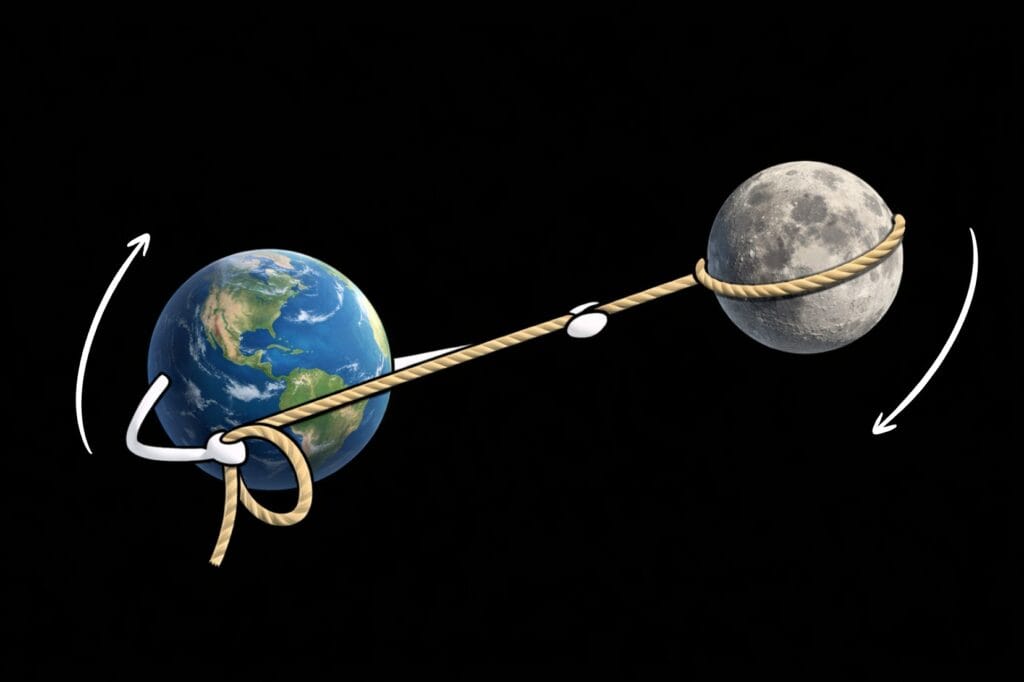
The Moon takes roughly 27.3 days to orbit Earth, and it also takes about 27.3 days to spin once on its axis. In physics, the term for how fast something is rotating is called angular speed and because these values are the same for the orbital rotation of the Moon and the spinning motion of the Moon on its axis, we find the same hemisphere always ends up facing Earth.
You can picture this by walking in a circle around a table while holding a book with its front cover pointing inward. To keep the cover facing the centre, you must rotate the book at a matching rate as you walk. If you turn it too quickly or too slowly, a different side would be seen. The Moon behaves in the same way as it orbits the Earth.
This synchronisation didn’t happen instantly. The Earth’s gravity creates slight tidal bulges on the Moon. Before the Moon and Earth were in sync, as the Moon rotated, these bulges were tugged out of alignment, producing a gentle twisting force (a torque) that gradually slowed its spin. Once its spin period matched its orbital period, the twisting effect stopped. The result is a tidally locked Moon, with one hemisphere always facing Earth and the other permanently turned away.
Seeing the Far Side for the First Time
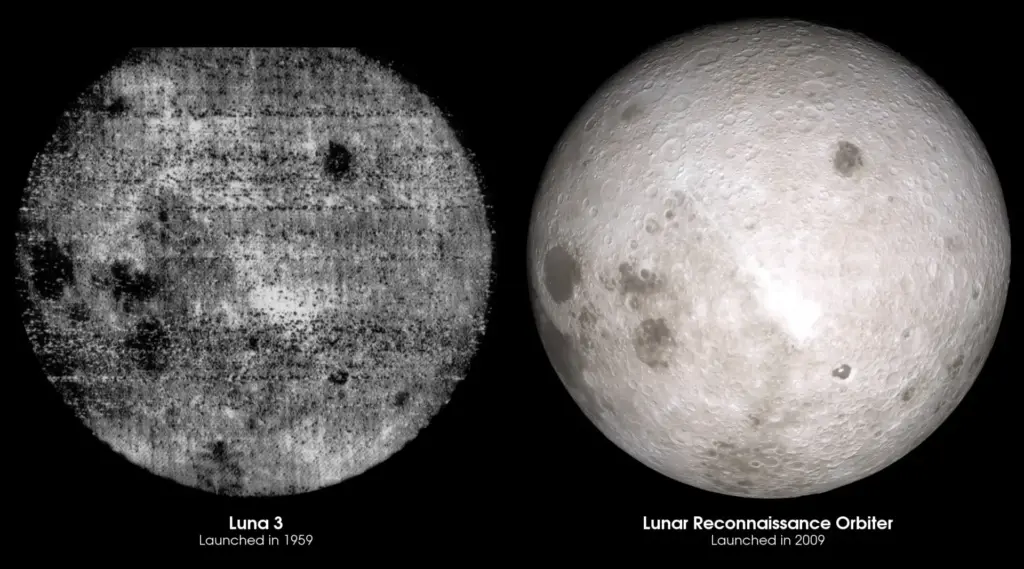
For centuries, nobody knew what the far side looked like. Telescopes couldn’t see beyond the lunar horizon, so astronomers assumed the hidden hemisphere must resemble the side that we’re familiar with. (The most logical assumption!) That idea remained untested until 1959, when the Soviet spacecraft Luna 3 became the first mission to photograph it.
According to NASA, Luna 3 snapped its first far-side photographs on 7 October 1959, capturing 29 frames over roughly 40 minutes during its flyby before returning toward Earth. The images were low resolution and showed the far side for the first time in human history, despite the technical limitations of the era. Luna 3 carried photographic film, exposed it in space, developed it onboard and transmitted analogue signals back to Earth. Engineers reconstructed the images by hand, producing grainy photographs. Because the transmission process was slow, analogue and required manual assembly, it took roughly 10–11 days after the flyby before the first usable images were available.
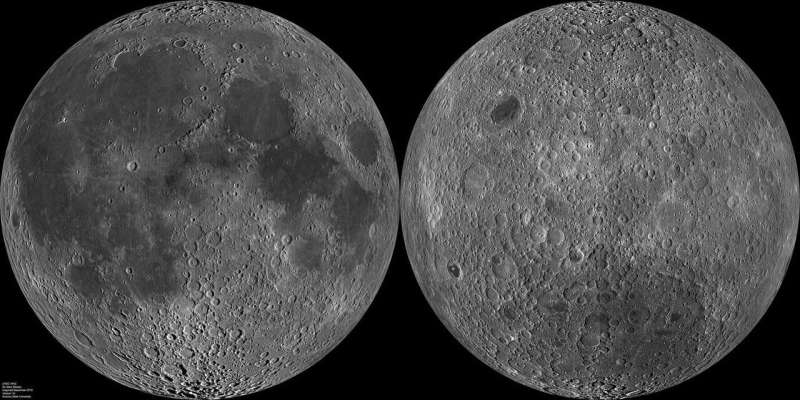
The results were surprising. Instead of the broad dark plains (maria) seen on the near side, the far side appeared bright, rugged and densely cratered (highlands). This discovery contradicted the assumption that the Moon was symmetrical and it raised new questions about its volcanic history, internal structure and whether Earth’s influence had shaped only one hemisphere.
Exploration continued through the Apollo era. When astronauts orbited the Moon in the late 1960s and early 1970s, each loop carried them over the far side. For roughly 45 minutes on every orbit, they were completely out of radio contact because the Moon blocked signals from Earth, highlighting how remote and isolated that region was.
In later decades, orbiters from Japan, Europe and the USA produced high-resolution imagery, topographic maps and mineral data. Today, scientists are interested not only in what the far side looks like, but also in what it could be used for. Because the Moon provides natural shielding from radio interference, the far side is one of the quietest locations in the Solar System and could be used to detect faint low-frequency radio signals that would otherwise be obscured near Earth.
The Real Reasons the Far Side Looks So Different
The striking contrast between hemispheres has nothing to do with sunlight or shadows. Instead, it reflects differences in the lunar crust, internal heat and the types of impacts that shaped the surface in the past. Scientists generally point to three main factors that help explain the difference.
- Crust thickness
Measurements from orbiting spacecraft show that the crust on the far side is significantly thicker than on the near side. A thick crust makes it far more difficult for molten rock to reach the surface. On the near side, where the crust is thinner, large impacts fractured the crust and allowed volcanic material to escape. These flood basalts filled deep basins and solidified into smoother, darker plains. On the far side, the thicker crust prevented most of this activity, leaving its surface rough and heavily cratered. - Fewer giant impact basins
The dark plains visible from Earth are ancient volcanic plains that filled enormous impact basins. To create them, you need a basin deep enough to weaken or fracture the crust below. The near side contains several vast basins, including Mare Imbrium, Mare Serenitatis, Mare Tranquillitatis and Oceanus Procellarum, which later flooded with lava and solidified.
The far side does have a colossal basin — the South Pole–Aitken basin — but the crust there remained too thick to produce widespread volcanic flooding. Most other basins on the far side are too small or too shallow to trigger major volcanic resurfacing. - Uneven internal heating
Evidence suggests the hemisphere facing Earth remained warmer for longer during the Moon’s early development. Several influences may have contributed to this, including tidal effects from Earth and differences in certain heat-producing elements. These influences may have kept the near side’s crust warmer and thinner, making volcanic activity more likely. The far side, lacking this extra heating, cooled quickly and developed a thicker crust.
Taken together, these factors suggest that volcanic plains form only when three conditions align: a large basin, molten interior material ready to escape, and a crust thin enough to break through. The near side had all three, but the far side did not.
What This Contrast Reveals About the Moon
The far side acts as a natural geological archive. Because it has not been resurfaced by extensive volcanic flooding, it preserves some of the oldest highland terrain, densely packed with craters. The near side presents a mixture of cratered highlands and smoother plains, offering a record of volcanic changes.
This contrast shows that the Moon is not geologically uniform. It also demonstrates how internal heat and crust thickness can shape the surface of a planetary body, helping scientists understand how crusts form, how planetary interiors evolve and how different worlds change over time.
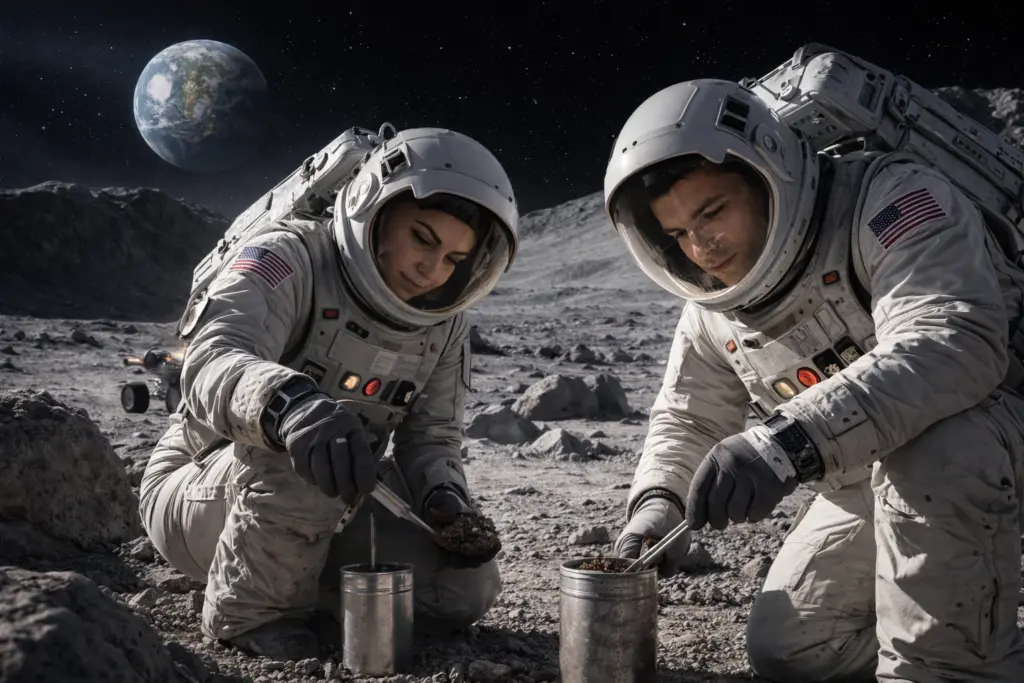
There are practical benefits too. The far side’s natural shield from Earth’s radio noise makes it a promising location for future radio telescopes capable of detecting extremely faint cosmic signals. Its ancient terrain also preserves a more complete record of early impact history, offering a valuable window into the bombardment environment of the early Solar System. Scientists also think the far side may contain good locations for drilling into the Moon’s crust and collecting ancient, undisturbed samples. Studying those samples could reveal what the early Moon — and even the Solar System — was like.
Myths and Misconceptions to Avoid
A common misunderstanding is that the far side is permanently dark. It actually experiences sunrise and sunset just like the near side, following the same month-long cycle. When the near side is illuminated as a full Moon, the far side is experiencing lunar night, and two weeks later the roles reverse.
Another misconception is that the far side looks different because it lies in Earth’s shadow. Earth only casts a shadow on the Moon during a lunar eclipse, which is rare and brief. The difference between hemispheres is due to crust thickness and volcanic history, not shadow.
Science fiction has also popularised the idea of hidden bases or artificial structures on the far side. Decades of high-resolution mapping have revealed no artificial features — only natural craters, basins and highlands shaped by impacts and internal processes.
Spacecraft and Missions That Explored the Far Side
1959 — Luna 3 (USSR)
Returned the first photographs of the far side, revealing its bright, cratered terrain for the first time.
1960s–1970s — Apollo Missions (USA)
Astronauts orbited the Moon and experienced long communication blackouts while passing over the far side, providing visual confirmation and navigation data but no landings.
1990s–2000s — International Orbital Mapping
A series of spacecraft, including missions from Japan, Europe and the USA, produced high-resolution topography, gravity maps and compositional data of the far side.
2019 — Chang’e-4 (China)
Achieved the first soft landing on the far side and deployed the Yutu-2 rover in the South Pole–Aitken basin, marking the beginning of surface exploration in this region.
Conclusion: A Two-Sided Story Written in Rock
For most of human history, the Moon appeared to be a familiar, unchanging world. When space missions finally revealed its hidden hemisphere, scientists realised that the Moon has two distinct geological regions. One side is dominated by volcanic plains created by thin crust and deep impact basins, while the other is rugged, heavily cratered and largely untouched by volcanic resurfacing.
As ongoing missions continue to map, land and explore, the far side may hold important clues about the Moon’s internal structure, early environment and potential uses in future space science. The hidden hemisphere is no longer mysterious, but it remains scientifically valuable and markedly different from the face we see every night.
This post was written by Laura Ash for Mission Astro.