
What is Artemis II?
Reading Time: mins
Artemis II will make history.
It is the first mission to carry humans to the moon’s vicinity since the Apollo missions, more than 50 years ago.
Four astronauts will venture on a 10-day looping journey around the Moon for Artemis II. This mission will take its astronauts further into space than anyone has been before. This mission builds on the unmanned Artemis I in 2022. Artemis II is testing the systems and hardware that will finally return humans to the lunar surface. This is the beginning of NASA’s plan to establish a long-term human presence at the Moon for science and exploration.
The rocket is ready to go!
NASA’s mega rocket was moved from where it was assembled to the launch pad four miles away, at Nasa’s Kennedy Space Center, Cape Canaveral, Florida. It took about 12 hours for the 98m-tall Space Launch System to make this journey. Now the final preparations and a dress rehearsal are being carried out.
In the news conference the crew said, “We’re ready to go.”
The Mission
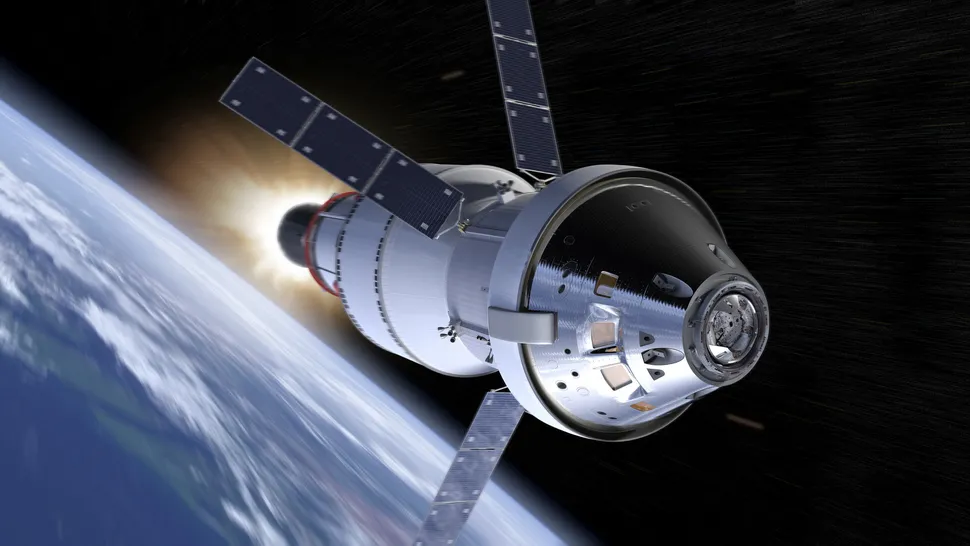
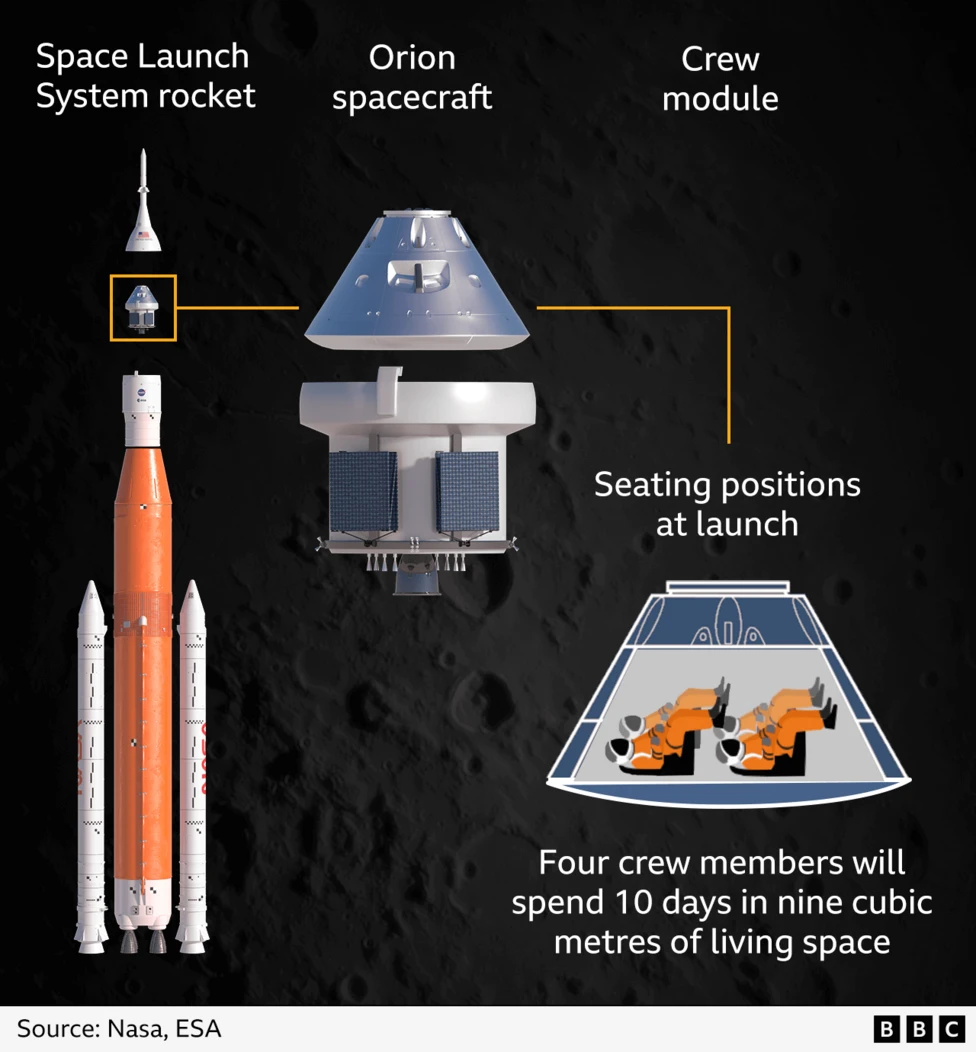
Artemis II is a crewed lunar flyby mission designed to validate Orion, SLS (Space Launch System) and the mission operations work as required, with crew aboard in the actual environment of deep space. A critical stepping stone testing these operations for future lunar landings where humans will return to the lunar surface in the next decade. Artemis II will be the first time humans travel aboard the spacecraft and venture beyond low Earth orbit since 1972.
After reaching low Earth orbit, the rocket’s upper stage will boost Orion into a highly elliptical orbit where astronauts will travel thousands of miles beyond the moon. They will experience deep-space radiation, and be able to test life-support, navigation and communications systems in real flight conditions to check they perform as expected.
The crew themselves will be medical test subjects, sending back data and images from deep space. They will only wear thier Orion Crew Survival System suit for launch and for re-entry into Earth’s atmosphere.
The crew will work in weightlessness in the small cabin. The radiation levels are higher than astronauts experience on International Space Station (ISS), which is in low‑Earth orbit, so still partly protected by the Earth, but still safe.
Astronauts will also take manual control of the spacecraft during this time in order to conduct a proximity operations with Orion and its European Service Module. These capabilities will play a critical role in future Artemis missions.
Launch date
6th February is the first possible launch date for the rocket to blast off. If this date isn’t possible the mission should definitely launch before the end of April, from Launch Complex 39B at Kennedy Space Centre in Florida. The exact date depends on successful final tests of the SLS rocket, Orion capsule (which carries the crew), and ground systems.
Technical details
Mission Type: Crewed Lunar Flyby
Crew size: 4
Launch: 6/2/2026 First estimated launch date
Duration: minimum 8 days
Launch mass of European Service Module: 13 500 kg
- 8600 kg propellant
- 240 kg drinking water
- 30 kg nitrogen
- 90 kg oxygen
Payload volume: up to 0.57 m3
Payload mass: up to 380 kg
The flight path
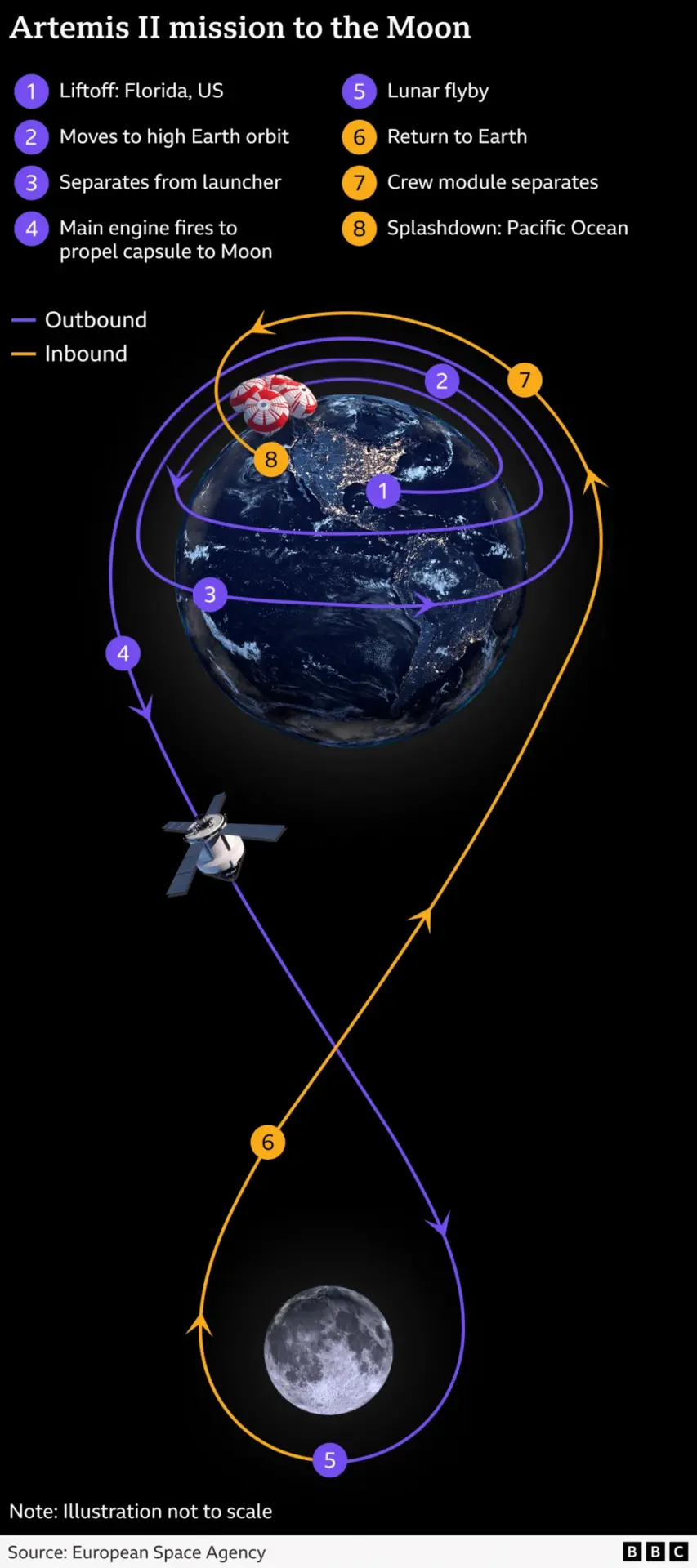
After launch, Orion will enter Earth’s orbit and orbit twice to ensure Orion’s systems are working as expected while still close to home with this first manned Artemis mission. Orion will then perform a series of engine burns that set up a hybrid free-return trajectory. This means a path that uses gravity to naturally loop around the moon and returns to Earth, even if there is a major system failure.
Artemis will take 4 days to journey to the moon, with a maximum altitude above the lunar surface of 5,523 miles (8,889 km). This elliptical orbit will see the spacecraft flying 4,700 miles beyond the moon. This means that at its farthest point, the Artemis crew will travel farther into space than any humans have before.
The mission is planned to last approximately 10 days, although there is flexibility to extend the flight if further testing is required. When they return to Earth the crew will splashdown in the Pacific Ocean.
The Crew
Meet the astronauts who will venture around the Moon on Artemis II, the first crewed flight to the Moon in half a century.
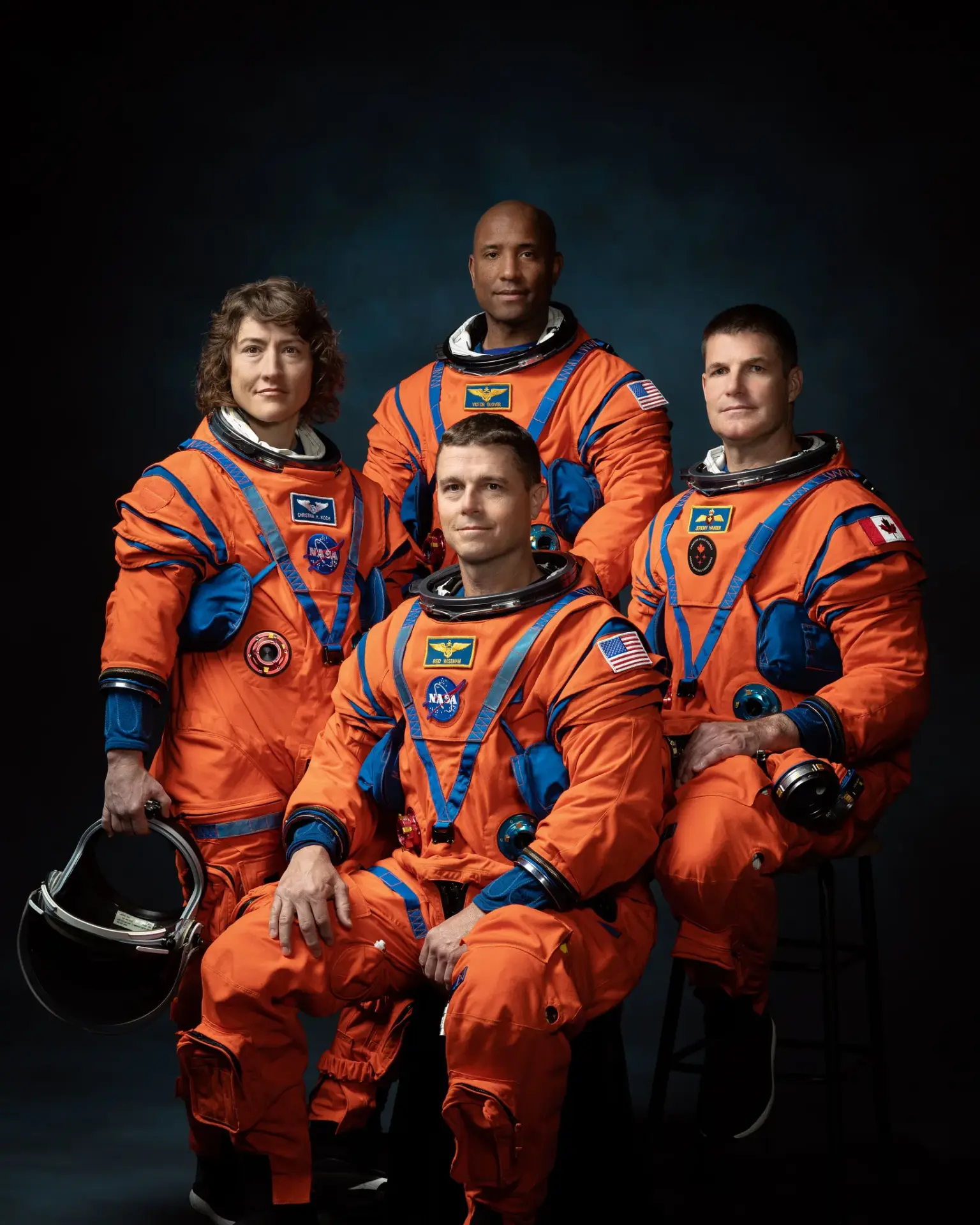
Reid Wiseman (NASA) – Commander
Reid Wiseman is a 27-year U.S. Navy veteran, aviator and test pilot selected by NASA in 2009. This will be Reid’s second spaceflight, following a 165-day mission aboard the ISS in 2014. During that mission Reid and his crewmates completed over 300 scientific experiments. These covered areas such as human physiology, medicine, physical science, Earth science and astrophysics. He also carried out almost 13 hours of spacewalks during two trips outside the ISS.
Reid is a father of two children, and he considers his time as an only parent, after his wife died, as one of his greatest challenges and the most rewarding phase of his life. Reid has a Bachelor of Science degree in Computer and Systems Engineering, a Master of Science degree in Systems Engineering, and a Certificate of Space Systems, from US Naval Postgraduate School.
Victor Glover (NASA) – Pilot
Victor Glover, selected by NASA in 2013, while serving as a Legislative Fellow in the United States Senate. Victor will be the first Black astronaut to fly around the moon. He previously served as pilot on NASA’s SpaceX’s Crew-1 mission, named Resilience, the first operational commercial crewed flight to the ISS.
Victor is originally from California, he gained an undergraduate engineering degree as a two sport athlete, while serving his community. Glover is a Naval Aviator and was a test pilot in the F/A‐18 Hornet, Super Hornet and EA‐18G Growler. Victor and his family have been stationed in various places in the United States and Japan and he has deployed in combat and peacetime.
Christina Koch (NASA) – Mission specialist
Christina Koch is an explorer, engineer and scientist selected as a NASA astronaut in 2013. She set the record for the longest single spaceflight by a woman, spending a total of 328 consecutive days aboard the ISS. Where she served as flight engineer. Christina also took part in the first all-female spacewalk.
Christina’s experience includes space science mission instrument development, as well as remote scientific field engineering in the Antarctic and Arctic. In her free time she has a wide range of hobbies: surfing, rock and ice climbing, programming, community service, triathlons, yoga, backpacking, woodworking, photography and travel.
Jeremy Hansen (Canadian Space Agency, CSA) – Mission specialist
Jeremy was selected by the Canadian Space Agency in 2009, and is a Royal Canadian Air Force fighter pilot. Artemis II is his first spaceflight. He will be the first Canadian to travel to the Moon. Jeremy has a Bachelor of Science in Space Science and a Master of Science in Physics. Jeremy grew up on a farm in Ontario. He is married with three children. In Jeremy’s spare time he enjoys sailboat cruising and racing, rock climbing and mountain biking.
Will Artemis II land on the Moon?
No, Artemis II will only fly by the Moon. The goal is to test that Orion, SLS, and mission operations can safely support astronauts deeper into space than ever before.
What’s next after Artemis II?
Landing on the Moon! The future mission Artemis III, is planned to land on the moon in 2027 at the earliest. This mission will land on the Moon’s south pole region. NASA’s goal is to then have a sustained human presence on the Moon, similar to the ISS.
Summary
Artemis II will launch on 6th February at the earliest, taking humans back to the Moon for the first time since 1972. Four astronauts will take a 10-day journey around the Moon, deeper into space than humans have ever been before. This mission follows the unmanned Artemis I mission. The next planned mission, Artemis III will finally return humans to the Moon.
This post was written by Dr Heather Campbell for Mission Astro.
If you have any questions about this post or our services, please contact us on missioastro.org.
References
- https://www.nasa.gov/mission/artemis-ii/
- https://www.bbc.co.uk/news/articles/c0q4w3l0wdvo
- https://www.space.com/artemis-2-humans-moon-orbit
- https://www.esa.int/Science_Exploration/Human_and_Robotic_Exploration/Orion/Artemis_II
- https://www.nasa.gov/feature/our-artemis-crew/
- https://www.nasa.gov/missions/artemis/nasas-first-flight-with-crew
- ihhttps://www.bbc.co.uk/news/articles/cly148lvyevo
- https://www.nasa.gov/blogs/missions/2026/01/17/nasas-moonbound-artemis-ii-rocket-reacheslaunch-pad/