
Geometry on a Cosmic Scale: The Surprising Flatness of Space
Reading Time: mins
If you could draw a triangle that stretches across the universe, what would its angles add up to? It sounds like a strange question, but the answer tells us something profound about the nature of space itself. On the largest scales imaginable, the universe follows geometric rules, and understanding those rules has led to one of the more unexpected discoveries in modern cosmology.
Before we can talk about whether space is flat or curved, we need to be clear about what geometry actually means. Geometry isn’t just about drawing shapes on paper – it’s about rules. These rules describe how space behaves: whether straight lines stay straight, whether parallel paths ever meet, and how angles behave when you draw large triangles. Geometry tells us how distances and directions work, even when we zoom out far beyond galaxies and clusters.
Geometry: The Rules Space Follows
Let’s take a tiled floor as an example of an everyday object that follows flat geometry. The tiles line up neatly, parallel edges stay parallel, and right angles behave exactly as we would expect. But if we try laying these tiles smoothly over a curved surface like a globe, we would find that the rules quickly break down. Geometry controls how space behaves, not what objects in that space look like.
Why Curved Space Feels Like the Obvious Answer
It’s easy to see why scientists would have expected space to be curved. Gravity bends light, pulls paths off course, and shapes the motion of planets, stars, and galaxies. Popular explanations often show space as something stretchy or flexible, like a fabric sagging under weight. These images help explain what happens close to massive objects, but they can also make us assume that space bends in the same way on the largest scales too.
If space bends so clearly around massive objects, it seems reasonable to expect that when you zoom out far enough, the entire universe will curve as well. It’s easy to imagine the universe as a huge rounded structure, like an enormous sphere, because bending and curvature are the features most often used to explain how space works.
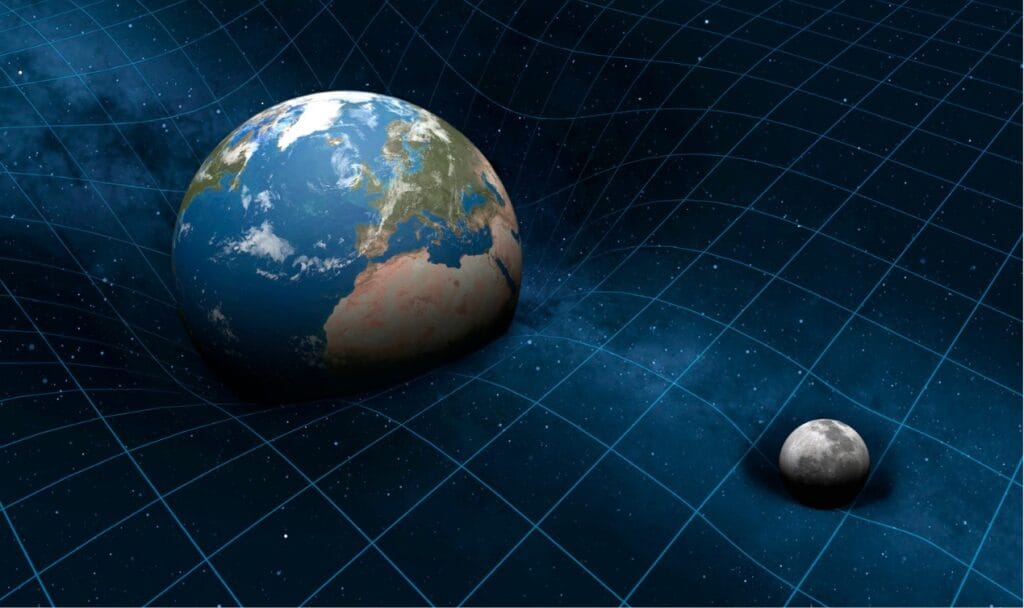
It was only when scientists began examining space across enormous distances that something unexpected emerged. Instead of finding obvious large-scale curvature, measurements suggested that space behaves in a surprisingly simple way. This idea, often described as the universe having “flat geometry”, can sound confusing at first. How can something so vast follow familiar geometric rules? What does “flat” really mean when applied to space itself?
What “Flat” Geometry Really Means (and What It Doesn’t)
One reason this idea causes confusion is that several concepts are often mixed together. Geometry describes the rules that space follows. Shape describes the overall form of something. Dimension describes how many directions you can move in. These ideas are related, but they are not the same. A room is three-dimensional, yet it follows flat geometry. You can move forwards, sideways, and up or down, but distances and angles behave exactly as Euclidean geometry predicts.
A helpful comparison is the Earth. A small patch of ground feels flat, and everyday measurements work as expected. Over large distances, however, curvature becomes unavoidable. Airline routes bend, straight lines eventually meet, and large triangles drawn between continents have angles greater than 180 degrees. The surface of the Earth follows curved geometry. In cosmology, flat geometry means that even when we zoom out to the largest observable scales, space behaves as if those familiar Euclidean rules still apply.
Geometry Is Not the Same as Shape
Another important distinction is between geometry and the overall shape of the universe. Geometry tells us how space behaves internally, while shape refers to the global form or extent of the universe. These are separate questions. Knowing that space has flat geometry does not tell us whether the universe has an edge, whether it is finite or infinite, or what it would look like from the outside.
Do scientists know whether the universe is finite or infinite? At present, they don’t know for certain. Observations allow them to measure the geometry of the observable universe, but they cannot reveal what lies beyond the limits of what we can see. A universe can follow flat geometry and still be finite, or flat and infinite. Geometry alone does not settle this question, which remains one of the open mysteries of cosmology.
The Geometry of Space: Curved or Flat?
On the largest scales, space can behave in one of three main geometric ways. It can have positive curvature, similar to the surface of a sphere, where straight paths eventually meet and triangle angles add up to more than 180 degrees. It can have negative curvature, often compared to a saddle shape, where straight paths spread apart and triangle angles total less than 180 degrees. Or it can be flat, following Euclidean geometry, where parallel lines remain parallel and the angles of a triangle always add up to exactly 180 degrees.
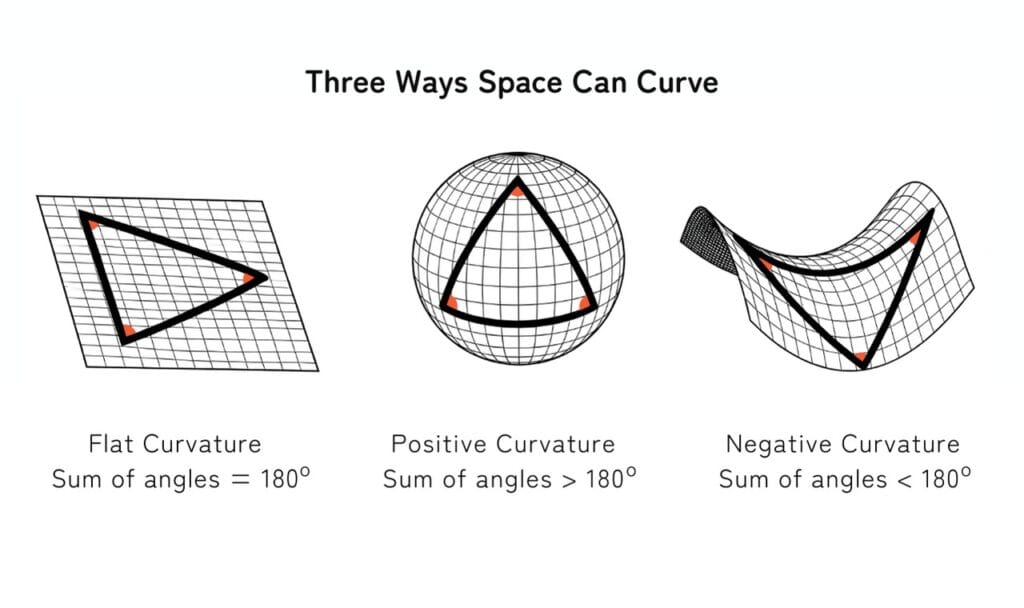
When scientists say the universe is flat, they are using a convenient way of describing this Euclidean behaviour. On the largest measurable scales, space behaves according to the same geometric rules taught in maths lessons at school. Distances scale in the expected way, straight paths remain straight, and angles behave exactly as Euclid would predict. This is a description of how space behaves, not what it looks like.
Why Flat Geometry Was Not the Obvious Outcome
Historically, many scientists expected space to show noticeable curvature on large scales. Einstein’s theory of general relativity showed that mass and energy curve space, transforming our understanding of gravity. It seemed natural to assume that the combined effect of all the matter in the universe would lead to an overall curved geometry.
As observations improved through the late twentieth and early twenty-first centuries, scientists were able to test these ideas more carefully. Instead of finding strong evidence for large-scale curvature, measurements repeatedly pointed towards space having flat geometry, or something extremely close to it. This result did not emerge because it was simple or convenient, but because increasingly precise data kept leading to the same conclusion.
Local Curvature Versus Global Geometry
At first, flat geometry appears to clash with the idea that gravity bends space. The key to resolving this is scale. Space can be strongly curved in small regions while still following flat geometry overall when averaged across enormous distances. A useful analogy is a gently rolling landscape. Up close, there may be hills and valleys, but from far enough away the terrain can appear flat. In the universe, gravity bends space around massive objects, but those local distortions do not automatically add up to global curvature.
How Can We Measure the Geometry of Space?
Measuring the geometry of space is challenging because there is no external viewpoint. Scientists rely instead on indirect evidence. They study how light travels across huge distances, how large-scale patterns of matter are arranged, and how angles and distances behave when measured across the observable universe. By comparing these observations with predictions from different geometric models, scientists can conclude whether space follows flat or curved geometry overall.
What Flat Geometry Does and Does Not Tell Us
Flat geometry helps scientists understand how space behaves and how distances scale across the universe. However, it does not answer every question. It does not explain how the universe began, why it exists, or what lies beyond the observable universe. It also doesn’t tell us whether the same geometric rules apply everywhere, or whether there are features we have yet to detect. These unanswered questions are part of what makes studying the universe so fascinating.
Common Misunderstandings About a Flat Universe
Many of the surprises surrounding flat geometry come from misunderstanding the term. Flat does not mean two-dimensional. It does not mean space is static or unchanging. It also doesn’t remove the local bending of space caused by gravity or describe the overall shape of the universe. Once these misunderstandings are cleared up, the geometry of space becomes far more interesting than it first appears.
Conclusion: Simple Rules on the Largest Scale
The geometry of space challenges our instincts. With gravity bending space locally and vivid imagery shaping our expectations, many scientists once anticipated large-scale curvature. Instead, studies showed something else. On the largest scales, space behaves according to familiar geometric rules. This does not remove mystery from the universe. Rather, it highlights how much we still don’t know. The surprising behaviour of space reminds us that the universe can be vast and complex, yet governed by simple principles that only become clear when we step back far enough to see the bigger picture.
Did You Know?
Did you know that space can follow flat geometry even while light bends dramatically around galaxies and black holes? This is because flat geometry describes the overall rules of space, not what happens in local regions. You can also draw enormous triangles across space using distant objects, and their angles still add up to 180 degrees!
Written by Laura Ash for Mission Astro.