
The Top 10 coolest facts about Enceladus
Reading Time: mins
Saturn’s moon Enceladus is a small, icy world and is one of the most intriguing destinations in our Solar System. It is a hot topic in Astronomy at the moment, with Cassini’s recent visit (first flybys in 2005) and the planned new mission Exobiology Extant Life Surveyor (EELS).
Here’s our favourite Top Ten Facts about Enceladus!
1. Enceladus is named after a giant in Greek mythology.
It was discovered on 29th August, 1789, by William Herschel when he observed a tiny bright dot orbiting around Saturn. It was later named by his son John Herschel.



2. Enceladus stats:
| Surface temperature | -200 degrees C |
| Average distance from Sun | 9.5 times the average distance from the Earth to the Sun |
| Orbital distance to Saturn | 148,000 miles |
| Diameter | 313 miles (about 500 km), which is quite small, about as wide as Arizona, smaller than France |
| Volume | 67.1 million cubic km, sixth-largest moon of Saturn |
| Gravity | 0.113 m/s² |
| Day | 32.9 hour |
| Atmosphere | Mostly water vapor; small amounts of nitrogen, carbon dioxide and methane |
3. Enceladus is the whitest, brightest and most reflective body in the Solar System.
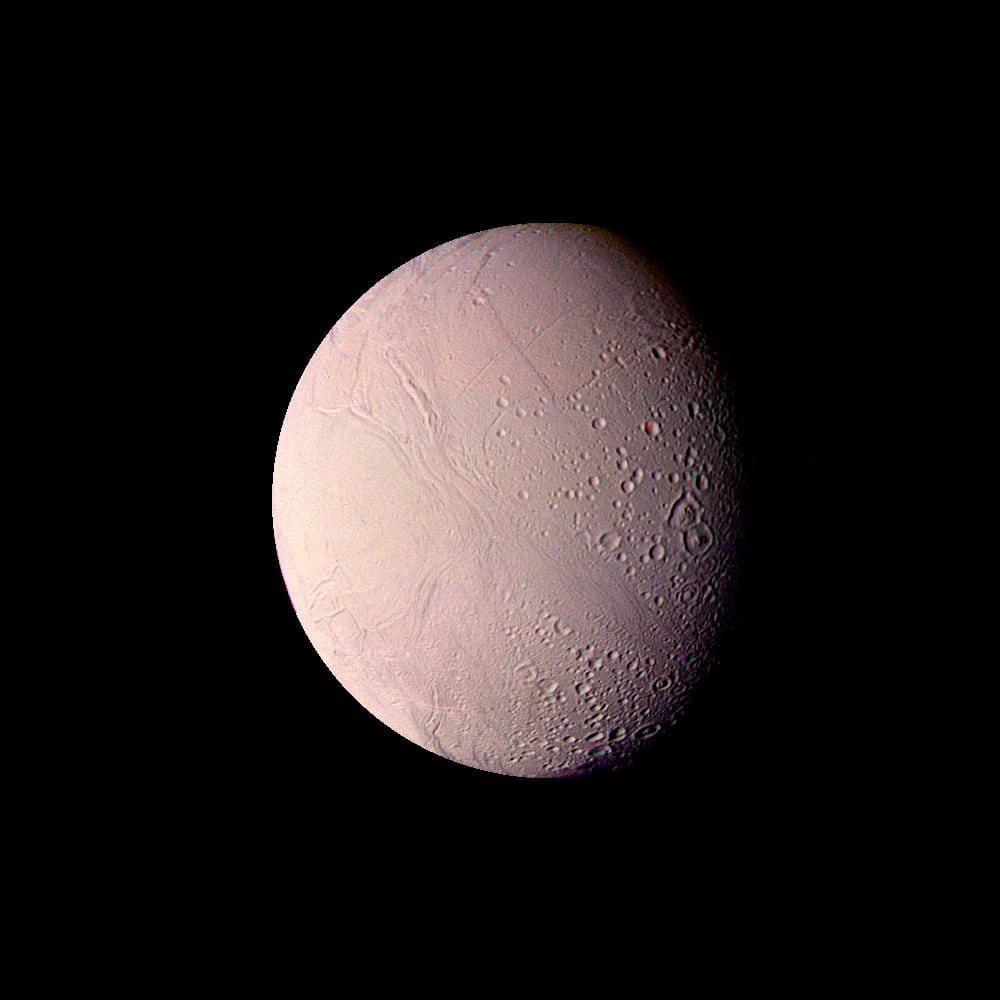
In the 1980s, we got the first close images, from the Voyager spacecraft, of Enceladus. These images showed this small moon’s icy surface is remarkably smooth in some areas, and bright white all over. For decades, scientists didn’t know why it is so reflective. Then they discovered that Enceladus reflects so much sunlight because it is coated in clean highly reflective ice. This also means that the surface temperature is extremely cold, about -200 degrees C. However, not all the surface is smooth. Some areas of Enceladus are covered in craters. Scientists believe these surface features indicate fairly recent geological processes which enabled the surface on Enceladus to renew.
4. Enceladus probably has a global ocean of liquid water under it’s icy surface.
The Cassini mission discovered the potential undercrust ocean while performing several flybys of Enceladus, starting in 2005. The subsurface ocean is tiny, only about 2% of all of Earth’s oceans. This sounds small, however Enceladus’ surface area is only about the size of France, so the ocean is actually quite large in comparison. Enceladus is extremely cold, meaning it is too cold for water to be liquid on its surface. Additionally, it lacks a thick atmosphere. Underneath the ice shell, the ocean is able to stay liquid due to a high salt content and being heated by the hot rock in the core of the Moon. The melting point of ice is lowered by salt in the water. Scientists think the heat source is “tidal heating”, this is Enceladus’ insides being stretched and compressed by the gravitational pull of its host planet, Saturn.
The ice shell is thought to be on average about 12 to 16 miles thick. Whereas, around the south pole the ice might only be between half a mile to 3 miles thick.
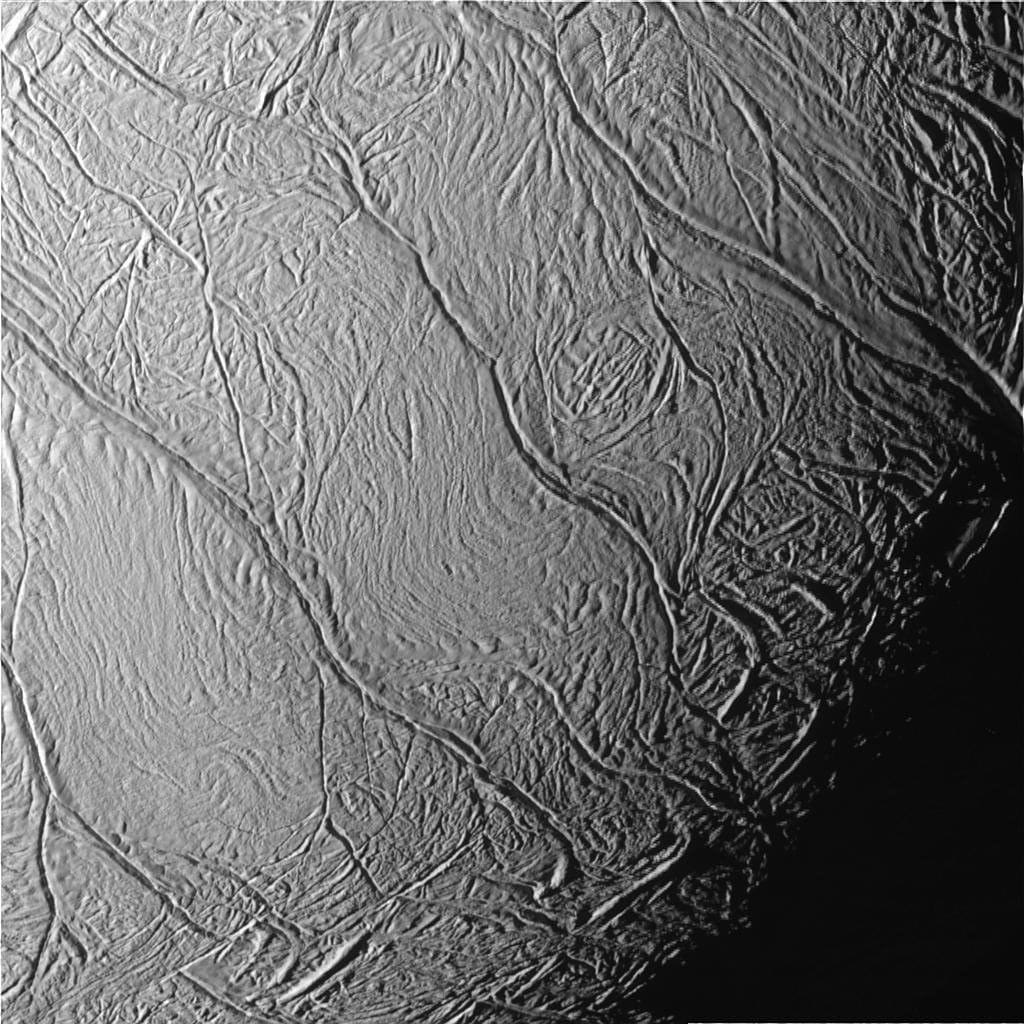
5. Enceladus has tiger stripes with dozens of geysers around its South Pole.
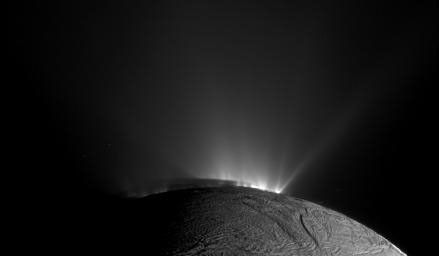
Cassini first discovered Enceladus distinctive ‘tiger stripes’ in 2005. Recent research discovered that there is a sliding side-by-side motion along these tiger stripes, linked to the geysers erupting from them sending up jets of ice crystals. This has become known as “Cryovolcanism”, and the jets are thought to originate from Enceladus’ buried ocean. Cassini also discovered that icy water particles and gas continuously gush out at approximately 800 miles per hour. This constant supply of material creates an enormous plume or halo of fine ice dust to gather over the south pole. The jets and brightness of the plume appear to vary in a pattern linked to the 33-hour orbit of Enceladus around Saturn. Scientists theorize tidal stress acting upon the tiger stripes causes these variations in the geysers.
NASA/JPL-Caltech/Space Science Institute#
6. Enceladus’ ocean could host life.
Enceladus’ sub-surface ocean is a potentially habitable environment for life. Excitingly in 2005, when Cassini flew through Enceladus’ geysers, it found evidence of organic compounds (basis for life as we know it)! Several gases have been detected including water vapor, carbon dioxide, methane, a little ammonia and either carbon monoxide or nitrogen gas, along with salts and silica. Liquid water is a key ingredient for life as we know it. Additionally, carbon and nitrogen are also chemical ingredients required for Earth-like life to thrive. The organic materials density in the plume was about 20 times denser than scientists predicted.
The geysers are fed by the under crust ocean, meaning scientists can study these geysers to investigate the interior of Enceladus, without having to send a probe to somehow drill into its icy shell. The findings could help determine if Enceladus’ subsurface ocean is favorable to life.
They also discovered hints of hydrothermal vents. This is exciting as on Earth, life can thrive without sunlight in hydrothermal vents. In fact, some scientists believe life may have originated there on our planet. Thus, their potential discovery on Enceladus is especially promising.
Cassini didn’t discover life on Enceladus. However, scientists consider it may be essentially habitable since it has all the right components for life: water, energy sources, and organic materials.
Great reasons to go back to Enceladus and take a closer look.
7. Enceladus creates a ring around Saturn
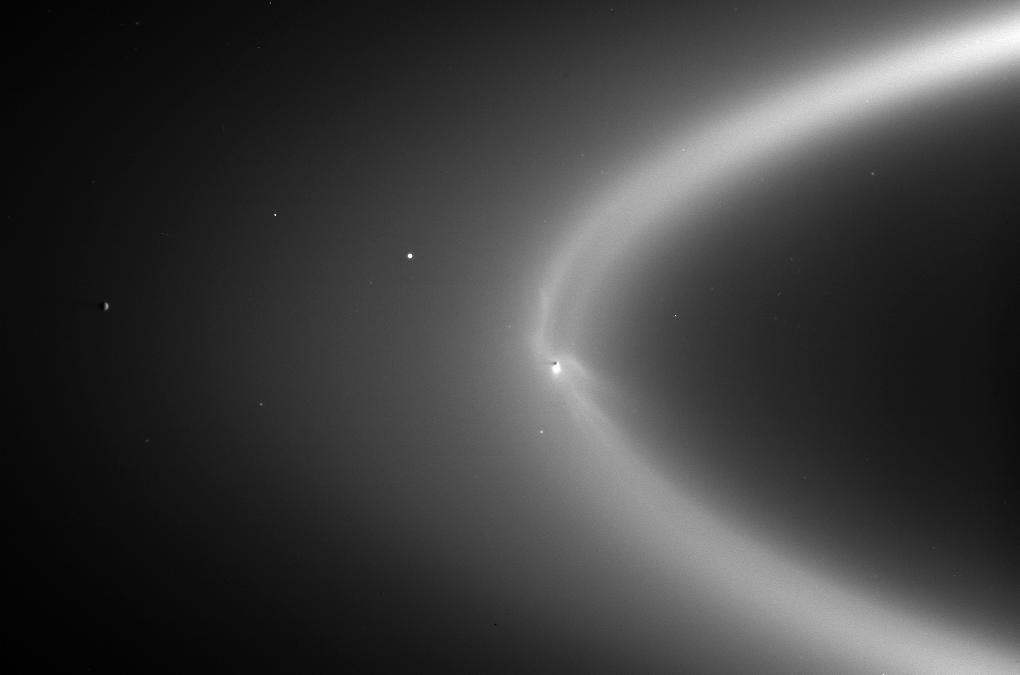
Most of the ice dust from the geyers falls back into Enceladus’ surface like snow, keeping it bright white. However, some of the icy particles spreads out into the space around its orbit, circling the planet to form Saturn’s E ring.
8. Enceladus is tidally locked with Saturn
This means its orbit and rotation on its axis both take the same length of time, 32.9 hours. Similar to our Moon and the Earth, Enceladus keeps the same face toward the planet as it orbits. Enceladus is trapped in an orbital resonance. This is when two or more moons interact gravitationally and line up with their parent planet at regular intervals. Enceladus orbits Saturn twice for every one of Dione, a larger moon, orbits. Since Dione’s is larger, it also has a larger gravitational force and this stretches Enceladus’ orbit into an elliptical shape. This means that Enceladus is sometimes closer and other times farther from Saturn. This is thought to cause tidal heating within Enceladus.

9. Enceladus has huge craters, some up to 22 miles in diameter
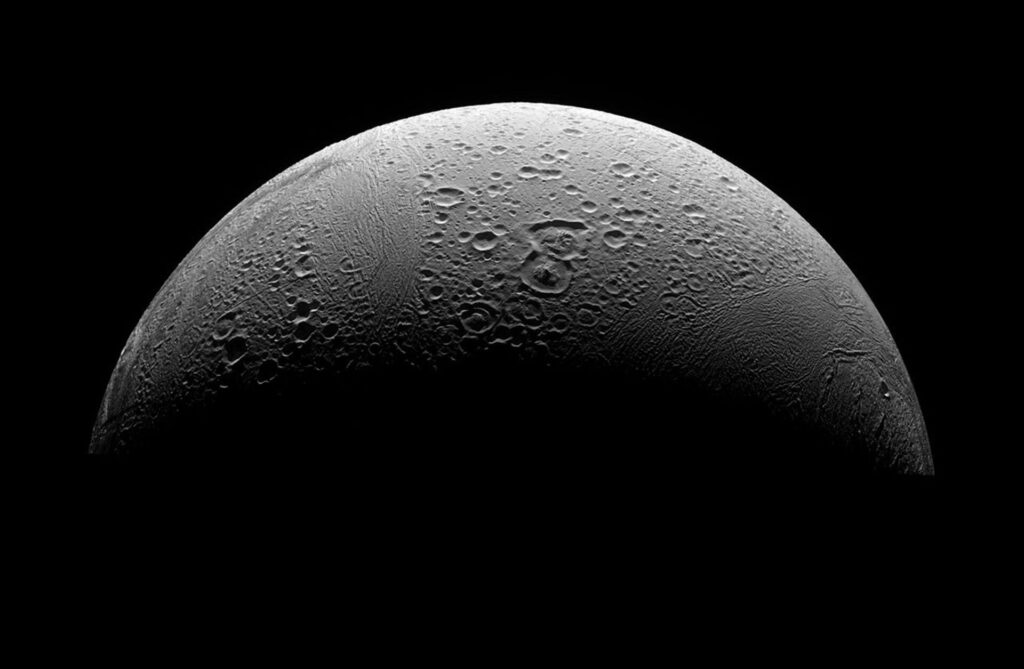
The north polar region appears to be much older than the south and covered with craters. These craters are captured at different stages of disruption and appear to be altered by tectonic activity, as well as past heating from below. The mosaic image below also shows a variety of impact crater shapes, some with bowed-up floors and smaller craters within, very likely indicating that the icy crust in this area was at some time warmer than at present. The two prominent overlapping craters near the centre in this view, Ali Baba and Aladdin, are among the largest craters found on Enceladus.
10. New EELS (Exobiology Extant Life Surveyor) mission
EELS is a snake-like self-propelled, autonomous robot. It is designed to go places no one has ever seen before, on its own, without human input in real time. The concept was inspired by a desire to descend the narrow, geyser-spewing vents in the icy crust, to search for signs of life hidden in the subsurface ocean on Enceladus. Currently EELS is undergoing testing and development for such a challenging destination.

Summary
Enceladus is one of Saturn’s moons. It is a relatively small, icy world which has geyser-like jets that spray water vapor and ice particles out into space. Enceladus is one of the most intriguing places in our Solar System as it has a liquid water ocean beneath its frozen shell, and sprays it’s ocean out into space. This means spacecraft can easily sample it. From these samples, scientists have discovered that Enceladus has lots of the chemical ingredients needed for life (including carbon dioxide and nitrogen). Additionally, scientists have found evidence of hydrothermal vents releasing hot, mineral-rich water into its ocean, which are thought to have helped start life here on Earth.
This post was written by Dr Heather Campbell for Mission Astro.
If you have any questions about this post or our services, please contact us on missionastro.org.
References
- https://www.planetary.org/worlds/enceladus
- https://science.nasa.gov/saturn/moons/enceladus/
- https://www.space.com/20543-enceladus-saturn-s-tiny-shiny-moon.html
- https://www.nasa.gov/history/235-years-ago-herschel-discovers-saturns-moon-enceladus/
- https://www.jpl.nasa.gov/robotics-at-jpl/eels/
- https://www.jpl.nasa.gov/news/jpls-snake-like-eels-slithers-into-new-robotics-terrain/
- https://science.nasa.gov/resource/the-north-polar-region-of-enceladus/
- https://www.jpl.nasa.gov/images/pia06247-tiger-stripes-up-close/
- https://www.planetary.org/space-images/eels-1-0-on-the-ice
- https://www.esa.int/ESA_Multimedia/Images/2025/10/Enceladus_orbiting_within_Saturn_s_E_ring
- https://www.nasa.gov/history/235-years-ago-herschel-discovers-saturns-moon-enceladus/