
Artemis II: Return to the Moon
Reading Time: mins
This year humans returned to the Moon, after more than 50 years!
Artemis II flew four astronauts to the far side of the Moon on a successful 10-day mission, taking people further into deep space than they have ever travelled before. Commander Reid Wiseman said they “saw sights no human has ever seen”.
The Launch
On 1st April 2026, Artemis II launched on NASA’s Space Launch System (SLS) rocket from the Kennedy Space Center, Florida. On board the Orion spacecraft, named Integrity, were 4 astronauts Reid Wiseman, Victor Glover, and Christina Koch from NASA and CSA (Canadian Space Agency) astronaut Jeremy Hansen. They are spending their 10-day mission in a small cabin just 5m wide and 3m high, which is about the size of a camper van.
The Journey to the Moon
Artemis II and its crew spent the first four days traveling to the Moon.
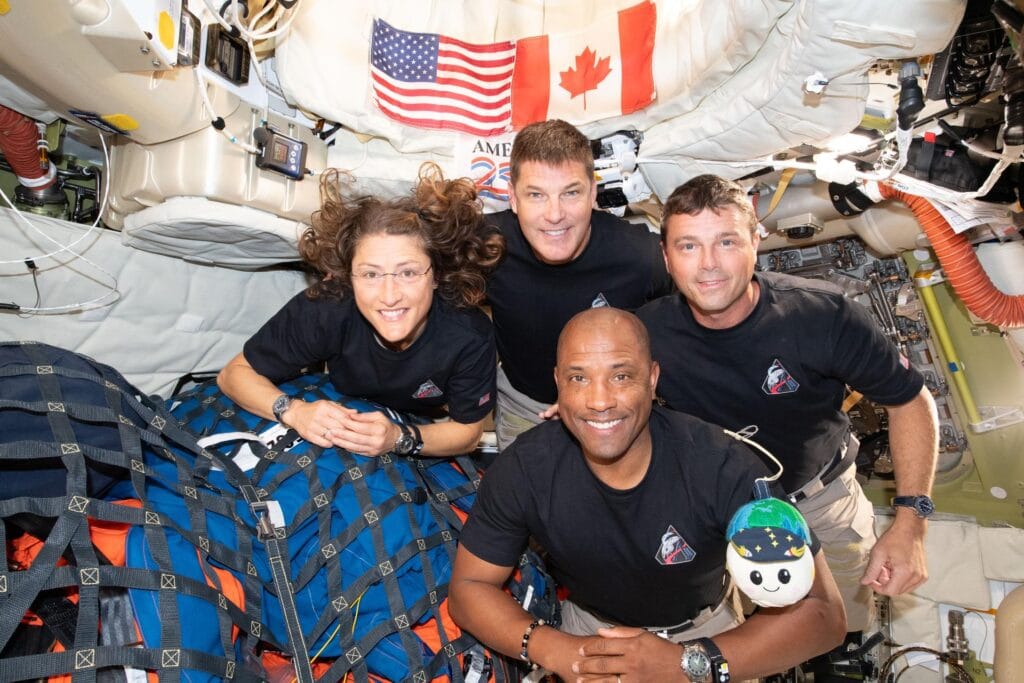
To begin the journey Orion orbited the Earth before heading to the Moon. This was to allow critical tests to be undertaken while Orion was still relatively close to home. One of the most important of these, called the proximity operations demonstration, was when the crew took manual control of the Orion spacecraft for approx. 70 minutes. During this time, the astronauts guided the spacecraft through a series of controlled approach and retreat manoeuvres.
The animation below shows Artemis II mission trajectory, from Earth orbit around the Moon and back to Earth, using flight-derived ephemeris data. Times are shown in UTC.
On Day 2 the Orion spacecraft fired its main engine for five minutes and 50 seconds, called the translunar injection (TLI) burn, sending the Orion crew out of Earth orbit and on a trajectory toward the Moon, becoming the first people to leave Earth’s orbit since Apollo in 1972.
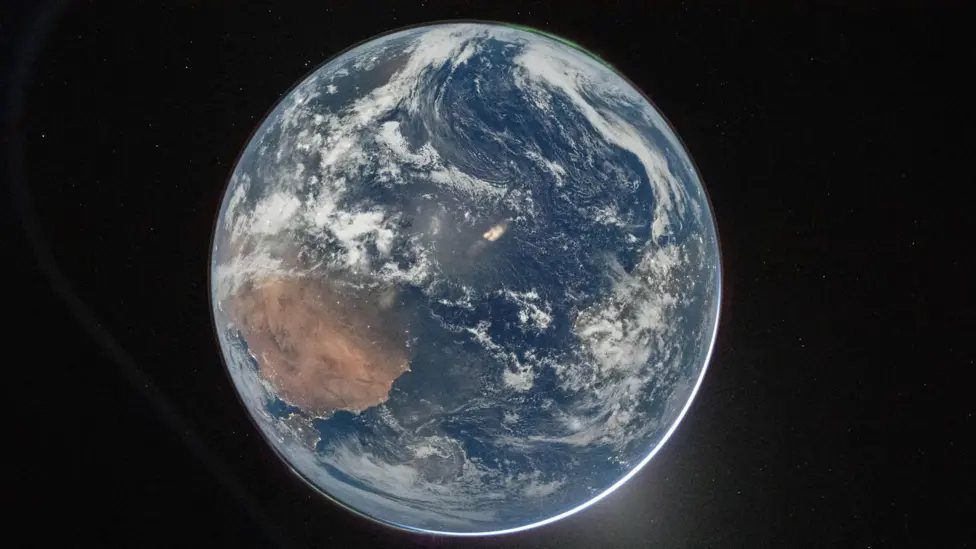
During the four day journey to the Moon, the astronauts started preparing for the lunar fly by and taking some amazing images. Here are a few of our highlights.
Firstly, this stunning first high-resolution image of the Earth taken as they passed the halfway point between the Earth and the Moon. This was taken by Reid Wiseman, the mission’s commander, after the final engine burn which set Orion on a trajectory towards the Moon. This image of the Earth shows the Atlantic Ocean as a vast expanse of blue, the Earth’s atmosphere glows as it eclipses the Sun and green auroras can be seen at both poles. It looks like the Earth is upside down, South America appears on the right and the western Sahara on the left.
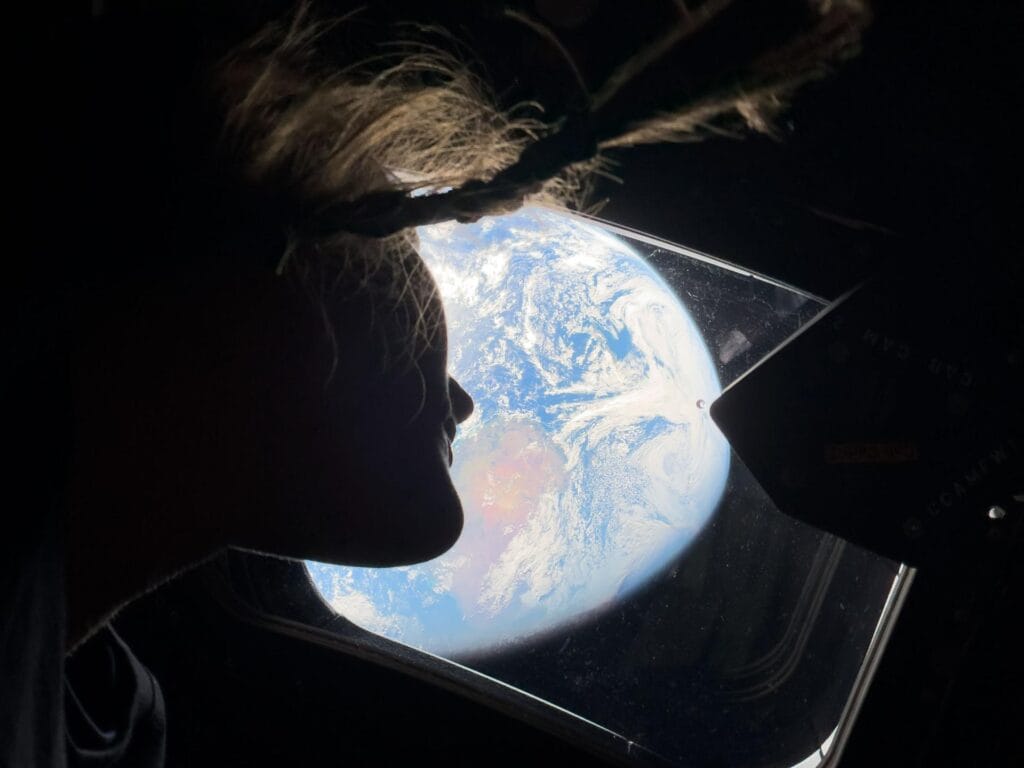
Another, iconic image shows Artemis mission specialist Christina Koch looking back at Earth out of one of Orion’s main cabin windows, as they travelled towards the Moon.
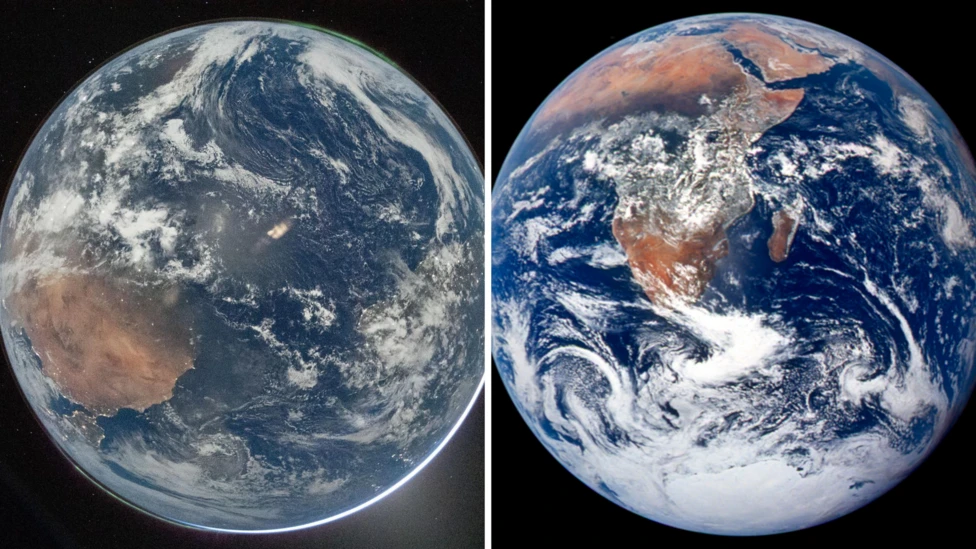
These side-by-side images of the Earth show an interesting comparison of the view these astronauts had in 2026’s and a similar image taken in 1972 by the Apollo 17 team, the last time humans walked on the Moon. NASA published this image with the quote “We’ve come so far in the last 54 years, but one thing hasn’t changed: our home looks gorgeous from space!”.
Investigating how deep space effects humans
Artemis II included several payloads which allowed NASA to understand how spacecraft systems, the crew, and biological samples responded to being in deep space.
The AVATAR payload carried the crew’s bone marrow cells, for researchers to study how the human immune system behaves in deep space. The crew also collected saliva samples, from which scientists can study the activity of the immune biomarkers. There were multiple radiation sensors on board to monitor and characterize radiation levels throughout the spacecraft. Additionally, the crew wore actigraphy devices, which were small, watchlike sensors that gathered health-related data.
Problems on board: the toilet!
The mission went really smoothly with hardly any problems. The only problem being early on there was an intermittent issue with the toilet on board Orion. At one stage, the toilet was unable to dump its waste overboard, NASA believes this was probably due to a frozen vent line. Instead, the astronauts had to use an alternative system for a while that involved collapsible plastic containers which collected their urine.
Exercising in space
In addition to the science that the astronauts carried out, they also spent time exercising while on their mission, to counteract the effects of the lack of gravity in space. They used Orion’s flywheel exercise device. It was a simple cable-based mechanism which allowed both aerobic exercise such as rowing and resistive movements such as squats and deadlifts.
How to wake up in space
Similar to previous crewed missions, the astronauts on Orion were woken up each day by songs they had chosen before flying. Some of their favourites included: a cover of Passion Pit’s “Sleepyhead” by Young & Sick, chosen by Christina Koch, “Good Morning” by Mandisa and TobyMac, which Victor Glover’s wife chose, and Chappell Roan’s “Pink Pony Club,” chosen by Reid Wiseman.
Here you can find the full Artemis II wake up songs on Spotify playlist
Artemis II Lunar Flyby
On the sixth day of the mission, Artemis II completed a seven-hour flyby of the Moon. This saw humans return to the Moon for the first time since 1972, as the crew circled the far side of the Moon.
The four astronauts onboard Artemis II made history at 1:56 p.m. EDT on April 6, when they reached 406,771 km (252,756 miles) from Earth travelling deeper into space than humans ever have before.
During the flyby, the astronauts spent time photographing craters and ancient lava flows, as well as describing its colour and texture. They took some breath-taking images of the far side of the Moon, these are a few of our favourites.
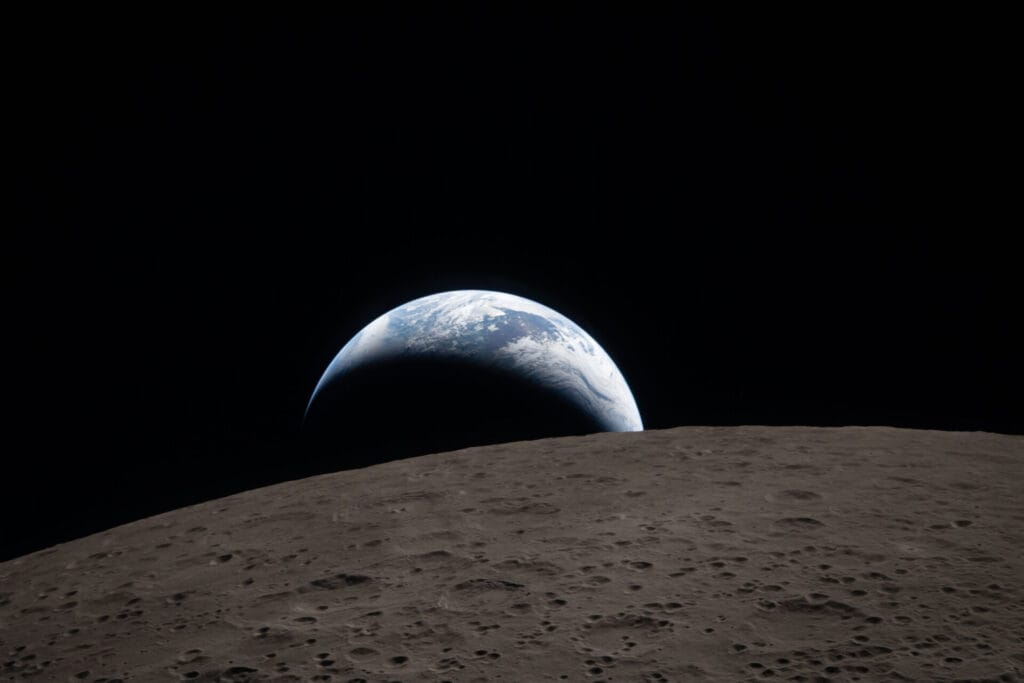
One of the most spectacular is this photo, which NASA has called ‘Earthset’. It shows the Earth slowly setting behind the cratered lunar horizon. This is similar to a famous ‘Earthrise’ photo taken during the Apollo 8 mission. The Ohm crater is in the foreground, it has terraced edges and a flat floor with peaks in the centre. These were formed when the lunar surface rebounded upward during the impact which created the crater. The Ohm crater is relatively young, only approximately 110 millions years old and about 53 miles in diameter.
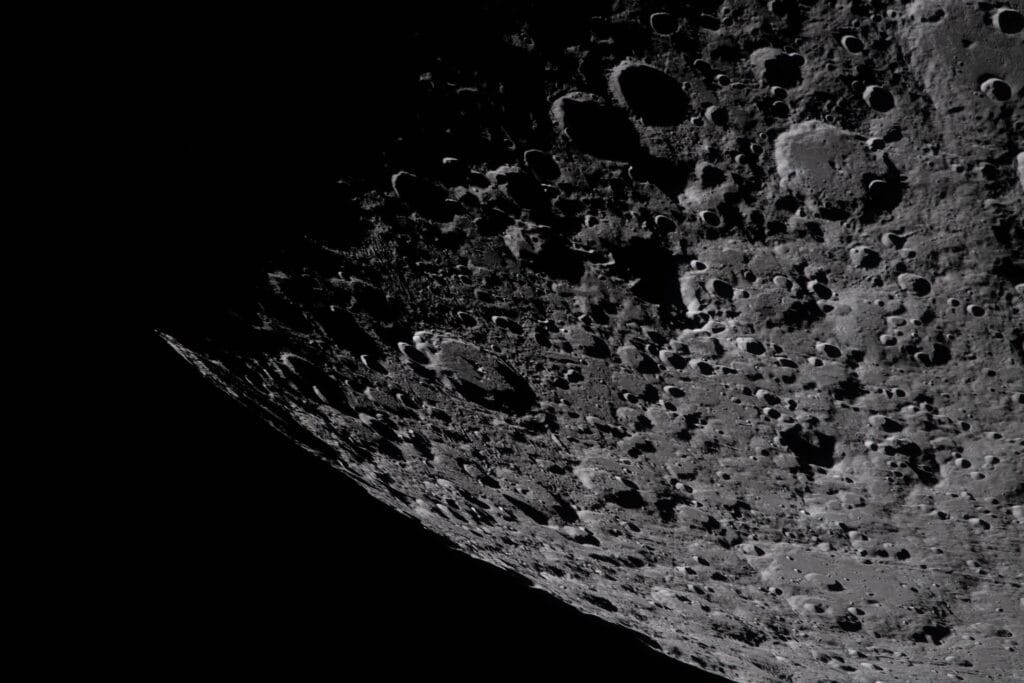
The next image shows a close up view of the far side of the Moon. It shows the heavily cratered terrain of the eastern edge of the South Pole-Aitken basin, and at the top of the image is the shadowed terminator (the boundary between lunar day and night). This basin is the largest (about 1,550 miles in diameter) and oldest (thought to be about 4.3 billion years old) basin on the Moon. Thus, we are glimpsing into an ancient geological history built up over billions of years.
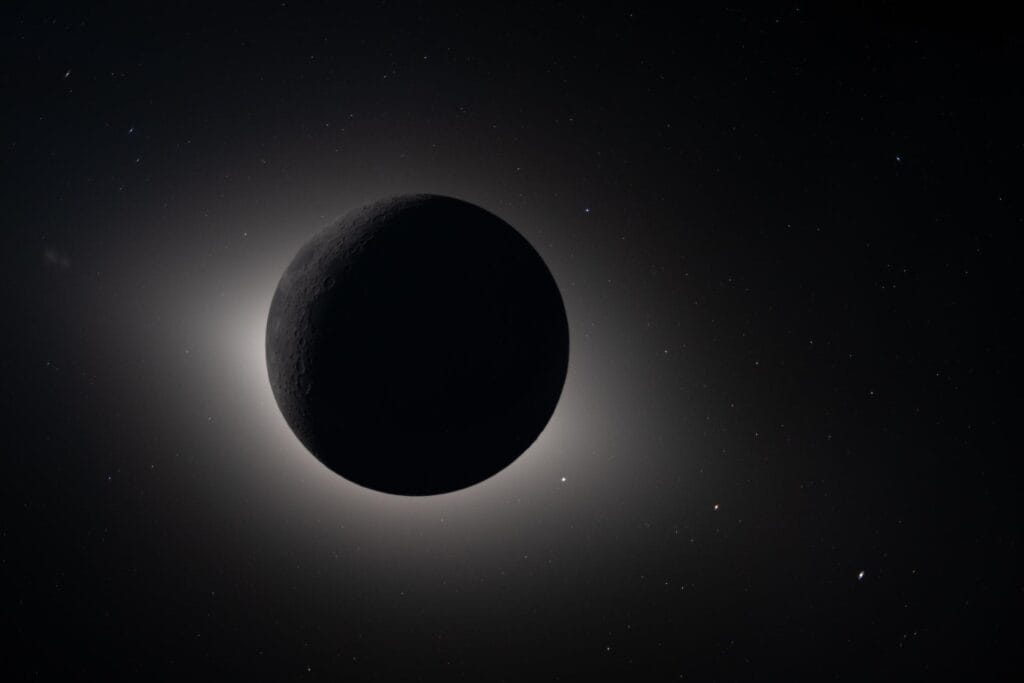
Another amazing images shows the Moon fully eclipsing the Sun. From the Orion spacecraft the Moon appeared large enough to completely block the Sun. Incredibly, the crew had this view of a total solar eclipse for nearly 54 minutes as they passed behind the Moon. The images shows the a glowing halo around the dark lunar disk. This could be from the solar corona, zodiacal light, or a combination of the two, the science community are investigating which. Stars are also visible, which are normally too faint to see when imaging the Moon. This unique vantage point allowed both a striking image and an incredible opportunity for astronauts to document their observations.
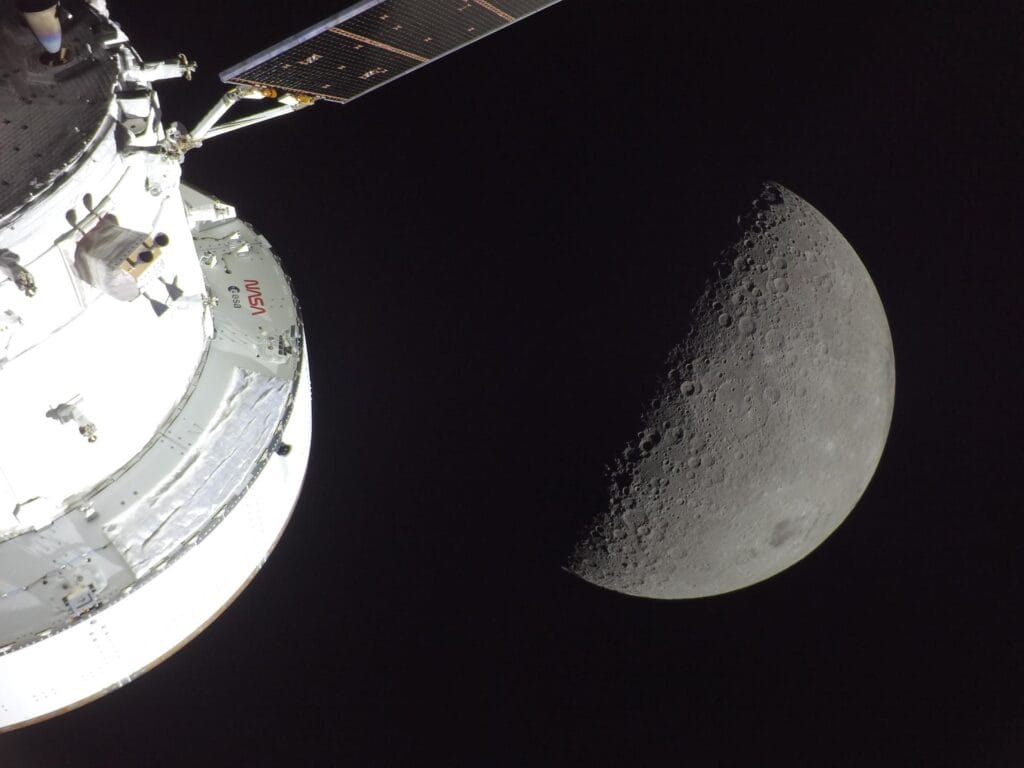
The next image really gives perspective of the Artemis II Mission. It shows the Orion spacecraft in the foreground, lit up by the Sun, with a first quarter Moon behind it. The Orientale basin stands out, with a black patch of ancient lava in its centre, near the bottom right edge of the Moon. This basin is a 600-mile-wide impact crater ringed by mountains. It straddles the near and far sides of the Moon, and until Artemis II it had only been imaged by robotic probes.
The crew lost contact with Earth for 40 minutes while behind the Moon, after which communication was restored as expected. After witnessing a solar eclipse, Orion headed back towards Earth. The crew continued their research on the return journey to Earth.
Artemis II Return to Earth: Splashdown and Recovery
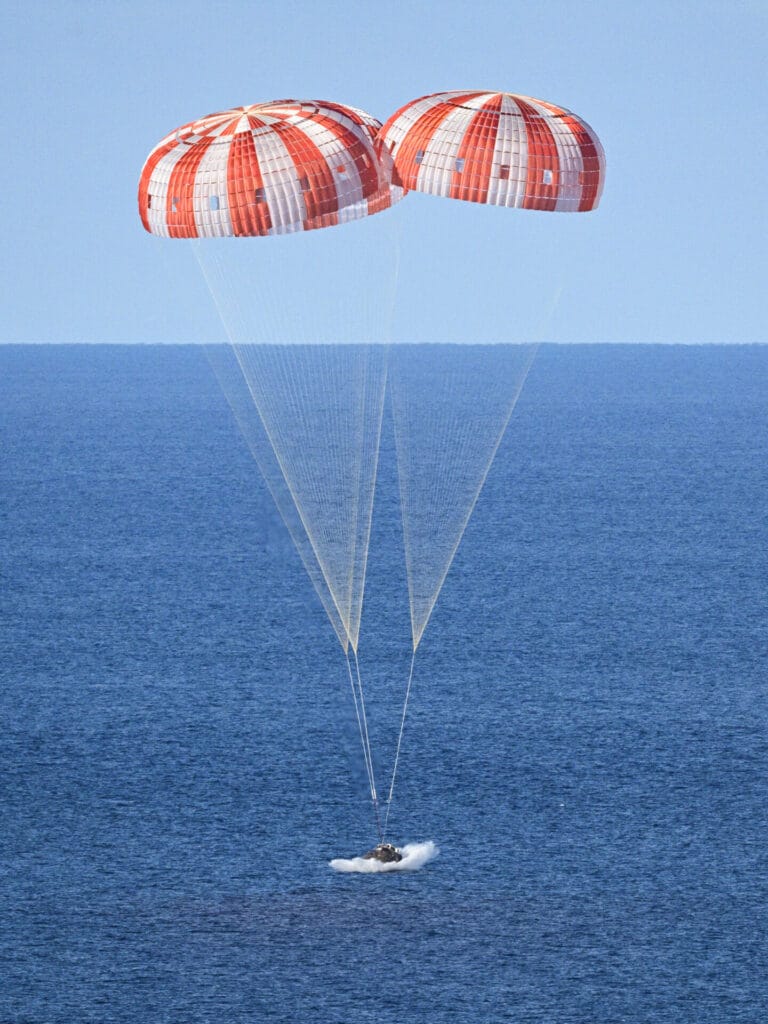
The four astronauts in Orion splashed down at 00:07 GMT on April 10, off the coast of San Diego, in the Pacific Ocean, safely returning to Earth after completing a nearly 10-day mission. The landing followed the Artemis II crew successfully re-entering the atmosphere after a routine but nerve-wracking six-minute communications blackout. The four astronauts were reported to be “happy and healthy”.
The future
NASA said that “This is the start of a new era of human space exploration.” Next, Artemis III mission will be in low Earth orbit to test integrated operations between Orion and either one or both commercial landers from SpaceX and Blue Origin. Then Artemis IV aims to return humans to the surface of the Moon by 2028. NASA’s long term goal is to create a dedicated ‘Moon base’.
Summary
After more than 50 year Artemis II returned humans to the vicinity of the Moon. This crew of four astronauts have travelled deeper into space than ever before, and it is the first time a female astronaut has visited the Moon. The mission allowed the Moon to be examined in close detail, sketched, photographed, and recorded by voice memos. As well as conducting important tests of the spaceship and human bodies in deep space. Glover said that “no adjectives could really capture what they saw”.
This post was written by Dr Heather Campbell for Mission Astro.
If you have any questions about this post or our services, please contact us on missionastro.org.
References
- https://www.bbc.co.uk/news/live/c3dlnzv5r71t
- https://www.nasa.gov/artemis-ii-multimedia/
- https://www.esa.int/ESA_Multimedia/Videos/2026/04/Artemis_II_around_the_Moon_in_10_days
- https://www.space.com/space-exploration/artemis/artemis-2-our-favorite-photos-from-nasas-historic-moon-mission
- https://www.nasa.gov/centers-and-facilities/ames/what-are-ames-contributions-to-artemis-ii/#:~:text=Artemis%20II%20was%20the%20first,needed%20for%20deep%20space%20missions.
- https://www.bbc.co.uk/news/articles/ce8jzr423p9o
- https://svs.gsfc.nasa.gov/5632/
- https://www.esa.int/Science_Exploration/Human_and_Robotic_Exploration/Orion/Artemis_II
- https://www.nasa.gov/blogs/missions/2026/04/02/artemis-ii-flight-update-perigee-raise-burn-complete/
- https://www.space.com/space-exploration/artemis/moon-music-heres-a-spotify-playlist-of-the-artemis-2-crews-wakeup-songs
- https://www.nasa.gov/blogs/missions/2026/04/01/artemis-ii-flight-update-proximity-operations-complete-perigee-raise-burn-up-next/