
The Tiny Rule That Shapes the Universe
Reading Time: mins
There’s a rule in physics that’s so small yet powerful enough to hold up entire stars. It doesn’t describe explosions, gravity, or energy. Instead, it places a simple restriction on electrons: they are not allowed to be identical. This idea, known as the Pauli exclusion principle, shapes the structure of matter—and determines the fate of stars.
Why Don’t Electrons All Fall Into the Same Place?
If you imagine an atom for the first time, it’s natural to think all the electrons should collapse into the lowest possible energy level, crowding as close to the nucleus as they can. Systems in nature tend to settle into their lowest energy state, so why doesn’t this happen?
If every electron could occupy exactly the same state, atoms would have no structure. There would be no layers, no patterns, and no periodic table. Every element would behave in roughly the same way. The fact that this doesn’t happen tells us something important: there must be a rule preventing electrons from piling into the same place.
Pauli’s Insight: Electrons Can’t Be Identical
In 1925, the Austrian physicist Wolfgang Pauli proposed an intriguing solution. He suggested that no two electrons in the same atom can share exactly the same set of properties.
This idea came from studying patterns in the periodic table. As scientists looked at heavier and heavier elements, they noticed something interesting. As the number of electrons increased, the electrons didn’t just pile into the same lowest energy state. Instead, they were forced into different levels. It was as if electrons couldn’t “sit in the same seat”. Once a space was taken, the next electron had to go somewhere else.
How Electrons Fill Space in an Atom
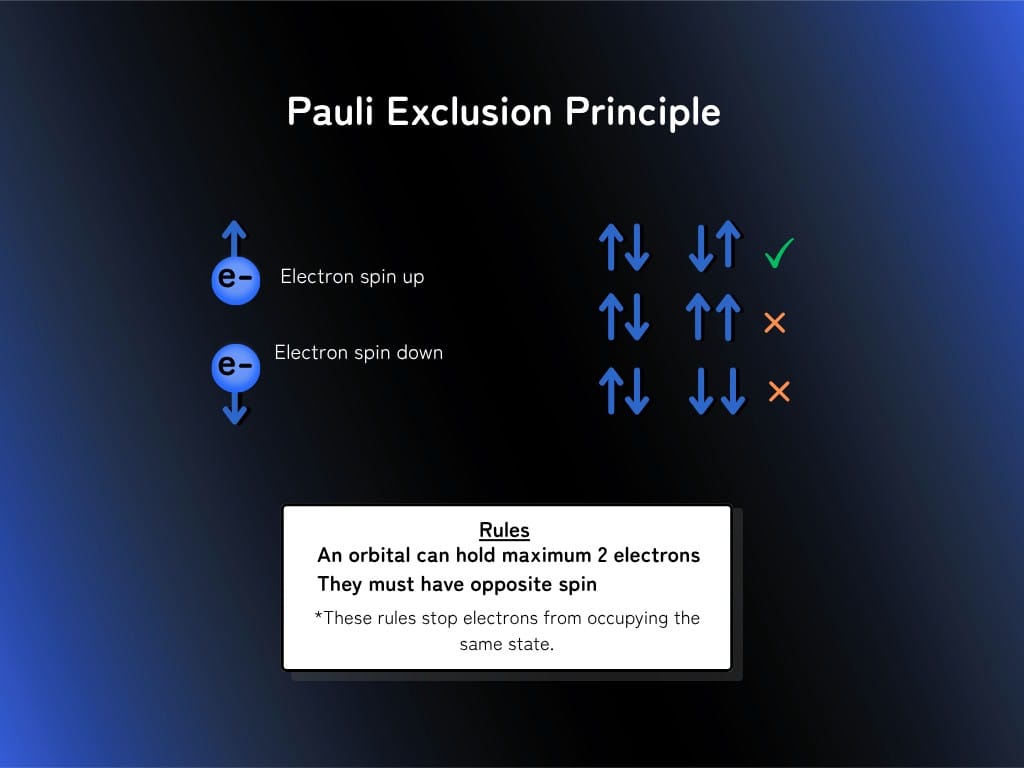
Electrons occupy regions of space called orbitals, grouped into energy levels. Each orbital can hold a maximum of two electrons—but only if they have opposite spin.
Each electron is defined by a set of quantum properties. These include its energy level, the region of space it occupies, its orientation, and its spin. The Pauli exclusion principle says that no two electrons can share all of these properties at the same time.
A helpful way to picture this is to imagine a cinema. Each seat can hold two people, but only if they are sitting in opposite ways. Once the lowest row is full, people have to move up to the next row. The rule doesn’t change, but the available space increases.
For example, helium has two electrons, and both can sit in the lowest energy level because they have opposite spin. But when you move to lithium, the third electron cannot fit into that same space. It is forced into the next energy level. This is why atoms build up in layers rather than collapsing into a single state.
What This Means for the Structure of Matter
Because electrons are forced into different states, atoms develop structure. The outer electrons determine how atoms interact, which is why different elements behave differently.
The Pauli exclusion principle is one of the key reasons the periodic table exists. It prevents electrons from crowding together and forces them into new arrangements, creating the differences we see in matter.
What Happens When a Star Collapses?
Now take this idea and scale it up.
When a star reaches the end of its life, it can no longer support itself against gravity. The star begins to collapse under its own weight, squeezing its matter into a smaller and smaller space.
As this happens, electrons are forced closer together. The number of available quantum states becomes limited. Eventually, there are no new states left for electrons to occupy.
When There’s No More Room
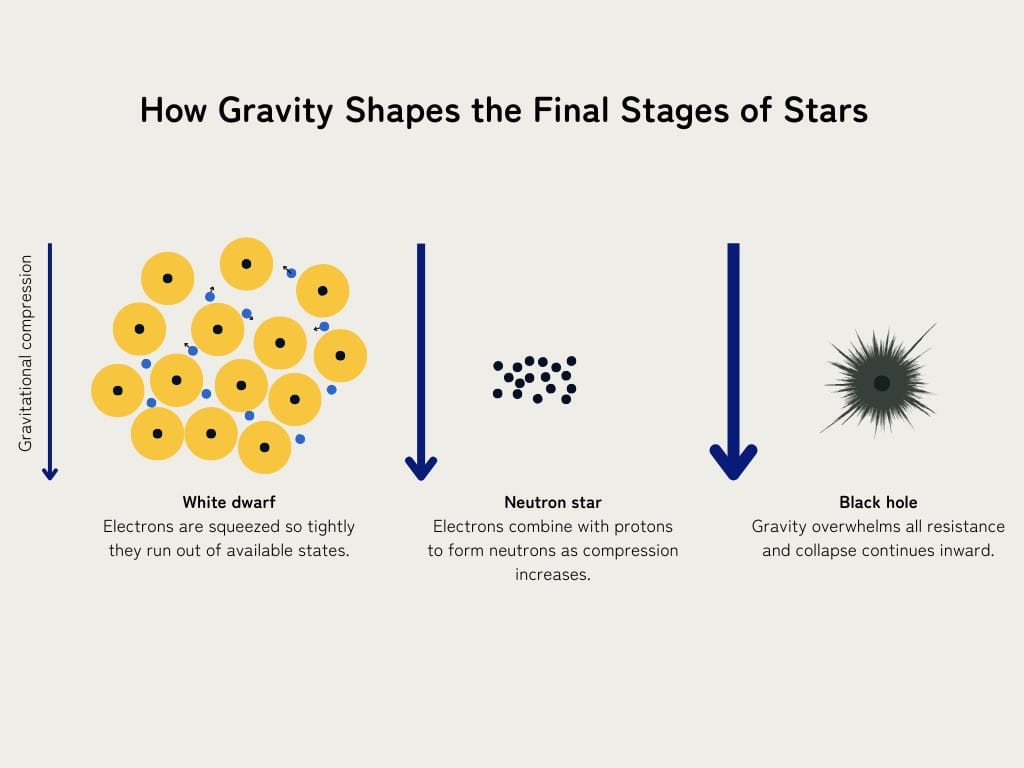
At this point, the Pauli exclusion principle becomes incredibly powerful. As electrons are squeezed closer together, they begin to run out of available quantum states. Because no two electrons can be identical, they resist being forced into the same state. This creates a powerful pressure that pushes back against gravity.
You can return to the cinema analogy here. Imagine every seat is full. If you try to force more people in, there is simply nowhere for them to go. The system pushes back.
In a collapsing star, this resistance is strong enough to stop the collapse entirely. The result is a white dwarf—a dense, compact object supported by the behaviour of electrons rather than energy generation.
Pushing the Limit: Neutron Stars and Beyond
This support has a limit. In the 1930s, physicist Subrahmanyan Chandrasekhar showed that if a star’s mass exceeds about 1.4 times the mass of the Sun, electron degeneracy pressure is no longer enough to hold it up. This is known as the Chandrasekhar limit.
When this limit is exceeded, gravity takes over again. In many cases, this leads to a powerful supernova explosion, but if enough mass remains, the core continues to collapse. Electrons are forced to combine with protons, forming neutrons, and the star becomes even denser.
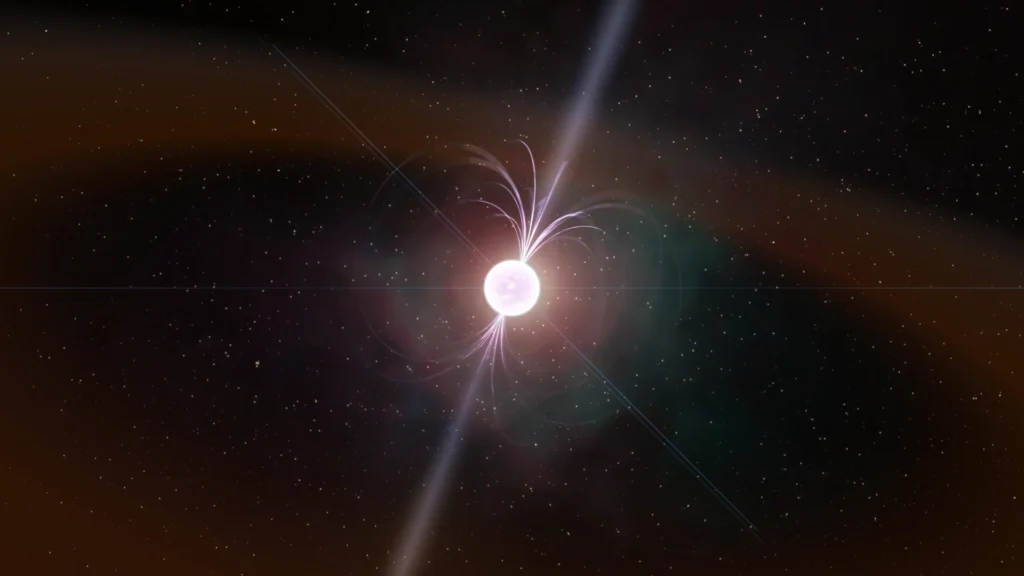
Now the same principle applies again—but to neutrons. They too cannot all occupy the same state, so they generate neutron degeneracy pressure, forming a neutron star.
If the mass is even greater, not even neutron degeneracy pressure can stop the collapse. Gravity overwhelms all resistance, and the star collapses completely, forming a black hole.
From Quantum Rules to Cosmic Objects
What began as a rule about tiny particles ends up shaping some of the most extreme objects in the universe. The Pauli exclusion principle prevents electrons from being identical, forces structure within atoms, and ultimately provides the pressure that can stop a star from collapsing completely.
From the arrangement of electrons in atoms to the formation of white dwarfs, neutron stars, and black holes, the same idea applies-particles cannot all occupy the same state, and that simple restriction has extraordinary consequences.
It’s a powerful reminder that the universe is connected in unexpected ways. A principle discovered while studying atomic behaviour turns out to govern the life and death of stars.
This post was written by Laura Ash for Mission Astro