
Fireballs in the Sky
Reading Time: mins
The Explosive Story of Meteors
Space may seem calm from our perspective, but above our heads are rocks racing through space at jaw-dropping speeds. When one dives into our atmosphere, it creates a dazzling trail of light burning across the sky. Let’s find out what really happens when these space-visitors race through our atmosphere!
Introduction
We often call them shooting stars or fireballs, but the real story starts with something called a meteoroid. A meteoroid is a rocky object travelling through space. It’s bigger than a speck of dust, but not quite as massive as an asteroid. Think of it like anything from a tiny pebble to a giant boulder, sometimes no bigger than a grain of sand, and other times several metres across.
Meteor Showers – When and Why They Happen
Meteor showers happen when Earth passes through a trail of debris left behind by a comet or asteroid. This debris contains small fragments of rock and ice (meteoroids) that were once part of the comet’s tail. As Earth moves through these cloud-like trails, the meteoroids enter our atmosphere and burn up, creating the bright streaks of light we call meteors.
Meteor showers typically occur at specific times of the year when Earth’s orbit crosses paths with the debris of a particular comet. One of the most well-known meteor showers is the Perseids, which happens every year around mid-August. These showers are named after the constellation Perseus, from where the meteors seem to originate. Another famous meteor shower is the Geminids, which occurs in December, and is known for producing bright and colourful meteors.
Meteor showers are a beautiful reminder of the constant movement and interaction between celestial objects in our Solar System. While meteors are often thought of as rare and random, meteor showers are predictable events that offer a spectacular natural display.
What Causes the Glow?
When a meteoroid enters Earth’s atmosphere, it’s speeding through at jaw-dropping speeds — often tens of thousands of kilometres per hour. Some meteoroids travel up to 70 times faster than the fastest plane on Earth! As it plunges through the atmosphere, it crashes into countless air particles. These collisions create so much heat that the surface of the meteoroid begins to glow, producing the bright streak we observe — a meteor. It’s not just the rock that’s glowing either; the air around it gets superheated, which intensifies the fiery trail that lights up the sky.
Atmospheric Effects
Think of Earth’s atmosphere as a massive, invisible shield that a meteor must break through. It’s dense enough to slow down or even disintegrate meteoroids before they reach the ground. As the meteor rushes through the air, it collides with countless particles, creating friction that heats up the meteor. This frictional heating intensifies as the meteor approaches Earth’s surface, often causing it to burn up or explode high in the atmosphere. When the meteor disintegrates, a shockwave is created — a burst of energy strong enough to cause damage, even if the meteor never hits the ground. This powerful shockwave can shake buildings and cause injuries, as seen in the Chelyabinsk meteor explosion in 2013.
What Damage Can a Meteor Shockwave Cause?
- Broken windows (the blast of air smashes them)
- Damaged buildings (cracked walls, collapsed roofs)
- Injuries (mostly from flying glass or falling debris)
- Setting off car alarms (caused by sudden pressure changes)
- Loud booms heard over huge distances
- Minor ground shaking (small tremors that rattle the ground)
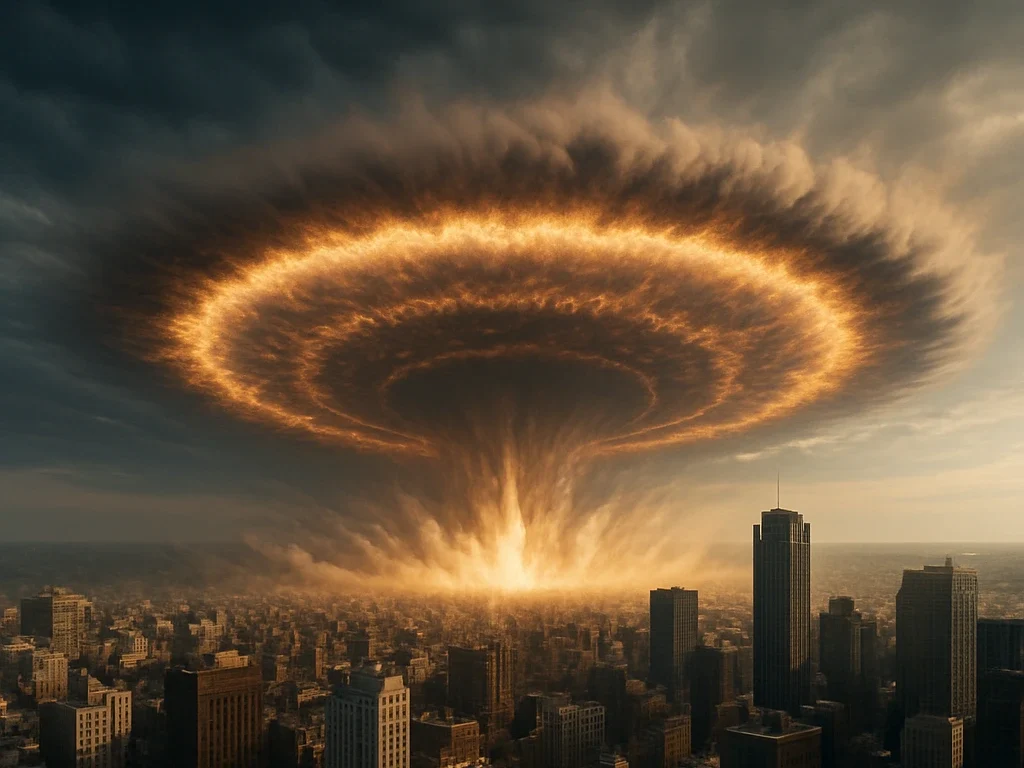
One of the most dramatic real-life examples of a meteor’s shockwave effects occurred in Chelyabinsk, Russia, in 2013. A meteor exploded in the atmosphere, creating a powerful shockwave that shattered windows, damaged buildings, and injured over 1,500 people. The blast was so intense that it knocked over structures, sent glass flying, and set off car alarms across the city. It remains one of the most significant meteor-related events in modern history.
For more details on this event, you can look up the Chelyabinsk Meteor online, which has been extensively studied by scientists and covered in many articles and documentaries.
Shoemaker-Levy 9 Hitting Jupiter
In 1994, the Shoemaker-Levy 9 comet collided with Jupiter, providing scientists with a dramatic demonstration of the power of space rocks. This event was significant because it was the first time scientists had observed a comet directly impacting a planet. As the comet approached Jupiter, it broke apart into multiple pieces due to the planet’s strong gravitational pull, resulting in a series of massive explosions across Jupiter’s atmosphere. The impacts left visible scars on Jupiter’s surface, which lasted for months. These explosions were so powerful that they created large, dark spots on the planet’s atmosphere — some of which were visible from Earth through telescopes. The Shoemaker-Levy 9 collision provided crucial insights into the effects of impacts on planetary bodies and emphasised how even massive planets like Jupiter are vulnerable to the forces of meteoroids and comets. The event also highlighted Jupiter’s role in the Solar System as a “cosmic shield.” Its immense gravity can attract comets and asteroids, sometimes pulling them toward the inner Solar System. While this can result in catastrophic impacts on other planets, Jupiter’s role in deflecting these space rocks also protects Earth from frequent collisions.
Role of the Atmosphere as Protective Shield
Earth’s atmosphere is crucial in protecting us from meteoroids and space debris. When meteoroids enter the atmosphere, they encounter air molecules that create significant friction, which causes the meteoroid to heat up rapidly. This intense heat causes most meteoroids to burn up before they can hit the surface. This natural shield is made up of several layers, each playing a key role in protecting life on Earth. The mesosphere, located about 50–85 kilometres above Earth’s surface, is particularly important because it is here that most meteors burn up due to the friction caused by air resistance. Larger meteoroids, however, may survive the atmosphere and reach the surface as meteorites, but this is rare. Without this protective atmosphere, Earth would be at greater risk from space debris. It prevents smaller objects from impacting the planet and so helps to avoid potential damage to our environment and life. Essentially, Earth’s atmosphere acts like a giant cosmic shield, deflecting and destroying most space rocks before they can cause harm.
Physics Behind Why Meteors Explode in the Sky
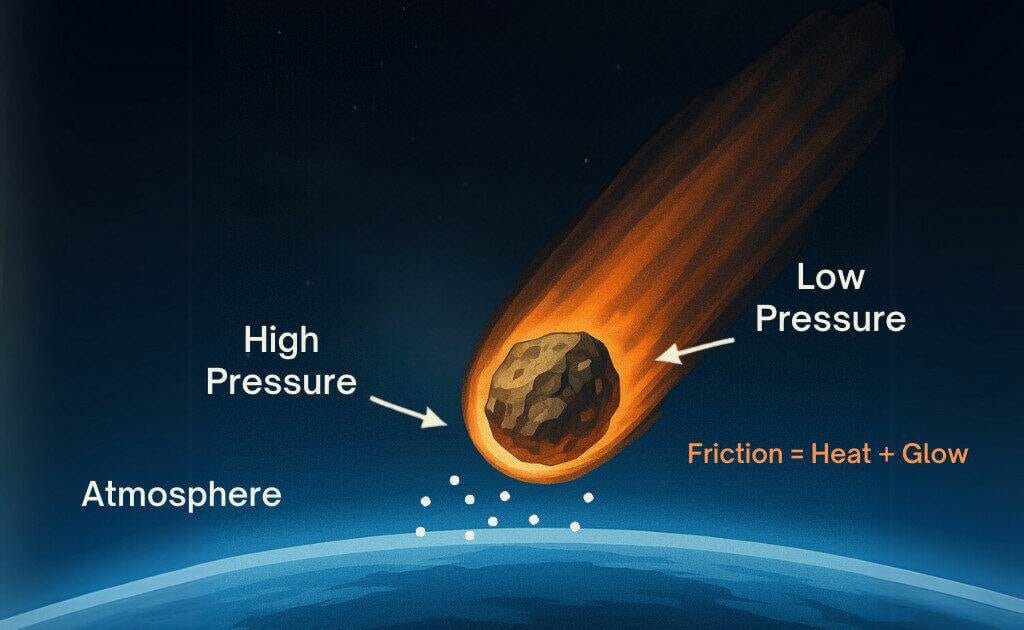
When a meteoroid enters Earth’s atmosphere, it faces extreme forces that make it heat up and often break apart. Moving at speeds up to 72 km/s, the meteoroid creates intense friction with the air molecules it encounters, generating enough heat to make the meteoroid glow, creating the bright streak we observe. The intense pressure difference between the front and back of the meteoroid contributes to its disintegration. The leading side of the meteoroid faces high pressure, while the rear encounters much less pressure. This imbalance causes stress that can cause the rock to crack or explode. The kinetic energy from this explosion is released as heat, light, and shockwaves, which can lead to dramatic events when the meteor breaks apart in the atmosphere.
Kinetic Energy Explanation
Kinetic energy is the energy an object has due to its motion. The faster an object moves, the more kinetic energy it possesses. For meteoroids, this is crucial because their speed plays a key role in how they interact with Earth’s atmosphere.
The formula for kinetic energy is:
Kinetic Energy = 1/2 mv²
Where:
- m is the mass of the object
- v is its velocity.
When a meteoroid enters Earth’s atmosphere, its high velocity gives it a massive amount of kinetic energy. As it travels through the atmosphere, this energy is converted into heat and light as friction causes the meteoroid to burn up. If the meteoroid is large enough, the energy can be so great that it causes the rock to explode, producing a bright flash and a shockwave.
The higher the velocity of the meteoroid, the more kinetic energy it has, and the more dramatic its entry into the atmosphere will be. This is why some meteors appear much brighter or larger than others — they are often moving faster and thus carry more energy.
Conclusion
Meteors, as they enter Earth’s atmosphere, are fascinating cosmic phenomena. From meteor showers lighting up the night sky to the dramatic explosions that create fireballs, these events help us understand both the dangers and beauty of space. The role of Earth’s atmosphere in protecting us and the physics behind why meteors burn up or explode is crucial for grasping the science of meteors. By studying these fast-moving space rocks, we learn more about our Solar System and how vulnerable Earth is to cosmic events.