
Our Universe through the crystal clear lens of ESA’s Euclid
Reading Time: mins
Summary
The Euclid space telescope has released some of their first spectacular images of our Universe. They showcase the huge field of view and razor-sharp image quality of the new optical and infrared telescope. Euclid is exploring our Universe to discover more about the mysterious dark matter and dark energy which make up most of our Universe.
The Mission
The European Space Agency’s (ESA) Euclid mission has been designed and developed to investigate the composition and evolution of dark matter and dark energy in the Universe. To achieve this goal the satellite will observe shapes, distances and motions of billions of galaxies to a distance of 10 billion lightyears, across over a third of the sky. Scientist will use this data to create the largest cosmic 3D map ever made of the large-scale structure of the Universe. The mission will explore how the Universe has expanded and how structure formed over time. This will help us understand more about gravity, as well as the nature of dark matter and dark energy. Euclid is different from other telescopes as it can create incredibly sharp visible and infrared images across a huge part of the sky at a time.
Euclid space mission launched on 1 July 2023, on a SpaceX Falcon 9, from Cape Canaveral, Florida, USA. It reached its destination of Sun-Earth Lagrange point 2, 1.5 million km from Earth, and focused the telescope on 28 July 2023. On 5 October 2023, the commissioning (period where the telescope is tested to make sure everything is working well) of the Euclid telescope was completed and the full 6 year mission began.
What is Dark Matter and Dark Energy?
The Universe is made of three main things, normal matter, dark matter and dark energy.
Normal matter is all the things we see with our eyes and in any other wavelengths of light (such as UV and x-rays). It is made of atomic matter – protons, neutrons and electrons. On Earth this is everything which surrounds us. However, in the Universe this is only about 5%!
Dark Matter behaves in a similar way to normal matter, in that it interacts with gravity. But we can’t detect it with any electromagnetic radiation, so at present it remains invisible to us. Scientists have measured that dark matter makes up about 27% of the Universe. However, we don’t know what it is!
Dark Energy is the largest proportion of our Universe, about 68%. We have very little idea what it is other than it is causing the Universe’s accelerating expansion.
First Images
On 7th October 2023 Euclid revealed its first colour images. These are revolutionary. This is the first time such razor-shape images have been taken of such large patches of the sky and at such a large distance in the Universe. These images show how well the Euclid telescope and instruments are performing. As well as showing the potential Euclid has to create the most extensive 3D map of the Universe. The images cover a range of objects Euclid will observe over the 6 year mission from bright stars to faint galaxies, and showcase the razor sharp images Euclid can create even when observing distant, faint galaxies. Allowing astronomers not only to learn about the dark Universe but also a wealth of information about the physics of individual galaxies and even stars.
Euclid’s view of the Perseus cluster of galaxies
![{"shape": [8800, 8800, 3]}](https://missionastro.org/wp-content/uploads/2024/06/euclid_s_view_of_the_perseus_cluster_of_galaxies_article.jpg)
This is one of the largest galaxy clusters in the Universe and is located only 240 million light-years away from Earth! Galaxy clusters are huge objects, held together by their gravity. They comprise hundreds or thousands of galaxies, hot plasma and dark matter. Euclid captured this revolutionary image of the Perseus cluster of galaxies. In the image, there are 1000 galaxies that are within the Perseus Cluster and also, over 100,000 more distant galaxies in the background. Many of these faint galaxies have never been seen before and their light has taken 10 billion years to travel to us. Mapping the shapes and distributions of these distant galaxies allows cosmologists to learn more about how dark matter shaped the Universe.
Galaxy clusters, such as Perseus are only possible with dark matter. Euclid will observe numerous galaxy clusters over the history of the Universe, allowing us to understand more about the dark matter binding them together.
Euclid’s view of spiral galaxy IC 342
![{"shape": [8200, 8200, 3]}](https://missionastro.org/wp-content/uploads/2024/06/euclid_s_view_of_spiral_galaxy_ic_342_article.jpg)
IC 342 is very nearby, only 11 million light-years from Earth! It is huge in the sky, about the same size as the full moon, which shows how huge the field of view of Euclid is. With other telescope, such as Hubble, many, many individual images would be needed to create a picture of the whole galaxy which Euclid is able to capture in just one image. This galaxy is similar to our own Milky Way, which is hard to study as we are inside it, so by investigating IC 342 we can understand more about galaxies like our own. This galaxy is nicknamed the ‘Hidden Galaxy’ but Euclid’s infrared view of it has already revealed crucial information about the stars in this galaxy. Over the mission Euclid will image billions of galaxies, allowing astronomers to investigate the influence of dark matter and dark energy.
Euclid’s view of irregular galaxy NGC 6822
![{"shape": [8200, 8200, 3]}](https://missionastro.org/wp-content/uploads/2024/06/euclid_s_view_of_irregular_galaxy_ngc_6822_article.jpg)
Euclid is creating a 3D map of our Universe, by observing galaxies out to 10 billion lightyears away. The majority of the galaxies in the early Universe aren’t like the picture perfect spirals and ellipticals we think of in today’s Universe. Instead they are small and irregular. They are the building blocks for the larger galaxies such as our own. We still see some of these types of galaxies around us. This image of NGC 6822 is such an irregular dwarf galaxy, only 1.6 million lightyears from Earth.
Euclid’s view of globular cluster NGC 6397
![{"shape": [8200, 8200, 3]}](https://missionastro.org/wp-content/uploads/2024/06/euclid_s_view_of_globular_cluster_ngc_6397_article.jpg)
As well as imaging galaxies, Euclid is also observing objects closer to home. Such as NGC 6397, the second-closest globular cluster, about 7800 lightyears away. Similar to galaxy clusters, globular clusters are collections of hundreds and thousands of stars bound together by gravity. Euclid is the first telescope to be able to image the whole cluster in one image and distinguish so many individual stars. The faint stars allow us to understand the history of the Milky Way and where dark matter can be found.
Euclid’s view of the Horsehead Nebula
![{"shape": [8200, 8200, 3]}](https://missionastro.org/wp-content/uploads/2024/06/euclid_s_view_of_the_horsehead_nebula_article.jpg)
The horsehead nebula is one of the most iconic and picturesque nebulae in the Universe, located in the Orion constellation. Euclid’s new image of it is spectacular and extremely detailed. With it, scientists hope to discover many faint and previously undiscovered young Jupiter-mass planets, young brown dwarfs and baby stars.
Euclid’s view of Abell 2390
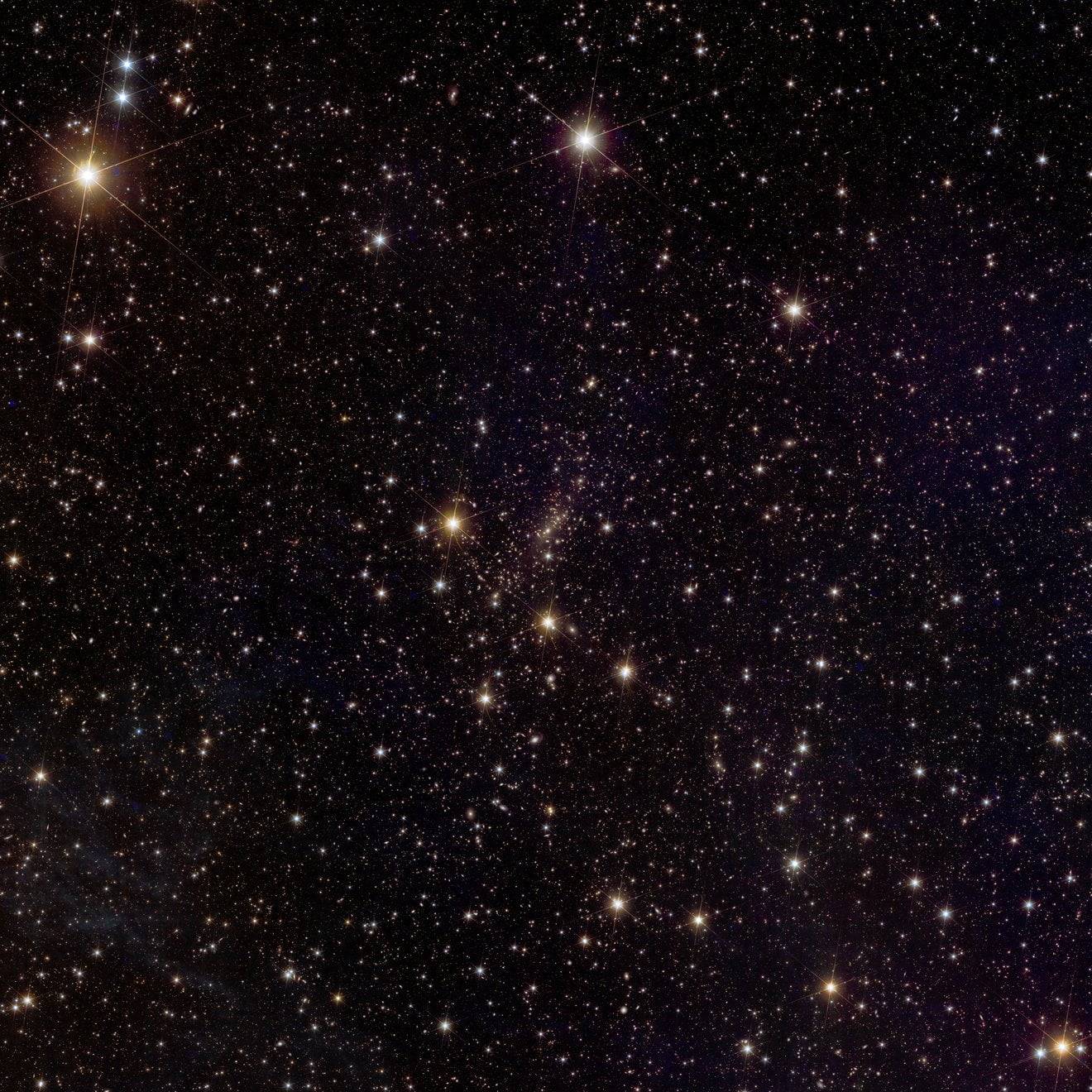
Credit: ESA/Euclid/Euclid Consortium/NASA, image processing by J.-C. Cuillandre (CEA Paris-Saclay), G. Anselmi; CC BY-SA 3.0 IGO or ESA Standard Licence
In this image of the galaxy cluster Abell 2390 you can see that some of the galaxies near the centre look stretched or smudged. The dark matter in the galaxy cluster has curved space-time and this has bent the light from the more distant galaxies making them appear bent or arced. When the warping is very strong, it can make the galaxies appear as rings, arcs or even multiple images of the same galaxy. This effect is called strong gravitational lensing and astronomers use it to learn about dark matter.
The bending of galaxies can also be used to learn about dark energy. But for this scientists need to look for much more subtle effects called weak gravitational lensing. This isn’t possible to see by eye, instead detailed computer analysis is needed to explore the smaller clumps of dark matter. Scientists map the dark matter and how it evolves over time to see how dark energy has changed the dark matter distribution.
As mentioned already, Euclid observes in visible light and near-infrared. This is because galaxies near-by emit mostly in the optical. Whereas galaxies further away in the background emit more light in infrared. Using both wavelengths means Euclid can observe galaxy clusters over a much wider distance in the Universe than if only one wavelength of light was used. Euclid takes these deep, wide, high-resolution images hundreds of times faster than other telescopes.
Conclusions
The Euclid space telescope has already started to wow the public and scientific community with amazing images of our Universe. The images demonstrate the large area of sky Euclid can observe at one time, in immense detail. As well as how much science can be discovered from these images. Over the next 6 years Euclid will discover much more about dark matter and dark energy in our Universe, revolutionising our understanding of the majority of our Universe.
This post was written by Dr Heather Campbell for Mission Astro.
If you have any questions about this post or our services, please email us on [email protected].
Take me to the FREE taster session for Mission Astro!
References
- https://www.jpl.nasa.gov/news/new-images-from-euclid-mission-reveal-wide-view-of-the-dark-universe
- https://www.esa.int/Science_Exploration/Space_Science/Euclid/Euclid_s_first_images_the_dazzling_edge_of_darkness
- https://www.esa.int/Science_Exploration/Space_Science/Euclid/ESA_s_Euclid_celebrates_first_science_with_sparkling_cosmic_views
- https://www.esa.int/Science_Exploration/Space_Science/Euclid
- https://www.esa.int/Science_Exploration/Space_Science/Euclid/Frequently_asked_questions_about_Euclid
- https://www.esa.int/Science_Exploration/Space_Science/Euclid/Euclid_overview
- https://www.esa.int/Science_Exploration/Space_Science/Euclid/Follow_Euclid_s_first_months_in_space#:~:text=19%E2%80%9328%20July.&text=In%20the%20month%20after%20its,arrived’%20at%20its%20destination%20orbit.
- https://science.nasa.gov/universe/dark-matter-dark-energy/