
From the Moon to Mars: How Astronaut Training Has Transformed
Reading Time: mins
The Evolution of Astronaut Training
Do you think you have what it takes to be an astronaut? Imagine spending years in a distant environment, with no connection to Earth, where survival depends on your training and where every decision could determine your survival.
Astronaut training has changed massively since the Apollo missions, but would those astronauts be ready for a Mars mission today? Let’s explore how astronaut training has evolved to prepare humans for the toughest journey yet—Mars.
We’re closer than ever to sending people to Mars, with missions expected to begin in the late 2030s. NASA, SpaceX, and China’s space agency are leading the way, and while interplanetary travel is still developing, astronaut training is rapidly evolving to meet the challenges of long-duration planetary missions.
But why are we so determined to explore Mars? Scientists believe that studying Mars can help us understand the history of our own planet, search for extra terrestrial life, and prepare for future human settlements. Learn more about why Mars is our next big frontier.
How Astronaut Selection & Training Has Changed from Apollo to Mars Mission
Becoming an astronaut has always been tough, but the required skills have changed a lot. During the Apollo era, nearly all astronauts were military test pilots with experience in high-performance aircraft. NASA focused on selecting candidates with engineering and piloting expertise, as spacecraft operations were the top priority. While physical fitness and problem-solving skills were essential, psychological endurance was not as well understood. You can find out more about Moon landings here.
Today, astronaut selection takes a broader approach. Space agencies now look for scientists, engineers, and medical professionals, not just pilots. Psychological resilience is now just as important as technical skills, as astronauts on Mars missions will experience long periods of isolation, stress, and delayed communication with Earth. Teamwork, adaptability, and problem-solving are now just as critical as traditional spaceflight skills.
Would Apollo Astronauts Pass Today’s Mars Training Tests?
If Apollo astronauts had to meet modern Mars mission standards, they wouldn’t necessarily qualify. While they were skilled pilots, they were not trained for the extreme psychological endurance needed for multi-year missions. Unlike the Moon missions, which lasted days, Mars astronauts will face prolonged isolation, long communication delays with Earth, and greater self-reliance. However, some Apollo astronauts, especially those with strong adaptability, could have succeeded with the right training.
Psychological Resilience Training
Astronaut training isn’t just about physical fitness—it’s also about mental strength. Spending months or years in a confined environment far from Earth can be incredibly tough, and only the most resilient candidates are selected. Psychological training focuses on several key areas:
✔ Cognitive Ability – Processing information quickly and making fast, logical decisions.
✔ Emotional Stability – Handling stress, pressure, and frustration effectively.
✔ Problem-Solving Skills – Thinking critically in extreme conditions.
✔ Teamwork & Communication – Working effectively in a team and communicating under pressure.
✔ Crisis Management – Staying calm and making the right decisions in emergencies.
✔ Adaptability – Adjusting to unpredictable situations.
✔ Confinement Tolerance – Coping with confinement in small spaces for long periods.
✔ Mental Endurance – Staying focused and motivated over long missions.
To prepare for the psychological strain of Mars missions, astronauts participate in isolation training in remote locations, such as Antarctic research stations. These experiences help them adjust to the loneliness and confinement they will face on a Mars mission.
Communication Challenges: Training for Delays and Autonomy
One of the biggest differences between Mars missions and previous spaceflights is communication. Unlike astronauts on the ISS, who can talk to mission control in real time, Mars astronauts will experience significant communication delays—up to 20 minutes one way. That means a simple question and response could take 40 minutes in total!
Astronauts must train to work autonomously, making decisions without immediate guidance from Earth. They must practise handling critical situations, solving technical failures, and making medical decisions without outside assistance. AI-driven support systems will help, but astronauts must still be self-reliant and able to work under pressure without instant feedback. You can discover more of the challenges astronauts would face on long space journey here.
How Virtual Reality is Revolutionizing Mars Astronaut Training
Astronaut training has advanced beyond physical spacecraft mock-ups. Today, virtual reality (VR) and augmented reality (AR) allow astronauts to simulate Mars landings, spacewalks, and emergency situations with great accuracy. AI-powered simulations test their decision-making abilities, training them to handle unexpected emergencies. In the future, training could include highly advanced holographic simulations, giving astronauts a near-realistic experience of Mars before they even leave Earth.
Physical Training for Long-Duration Spaceflight
Learning to adjust balance is key, as astronauts must operate in different gravity settings, from the complete weightlessness of space to the lower gravity of Mars. On Earth, we are used to a gravitational pull that keeps us grounded, but on Mars, gravity is only 38% of Earth’s gravity. This weaker gravity affects movement, balance, and even basic tasks like walking or lifting objects. https://mars.nasa.gov/files/resources/Planet-Mars-Quick-Facts_Mars-nasa-gov.pdf
Going to Mars isn’t just a mental challenge—it’s also a major physical one. Astronauts will spend months or years in microgravity, which weakens muscles and reduces bone density. Without regular exercise, they could struggle to function when they arrive on Mars.
To counteract these effects, astronauts undergo intensive resistance training. Scientists also study fluid shifts in the body to understand how space affects circulation and balance. Training in different gravity settings is essential because movement and coordination would be very different from what we experience on Earth
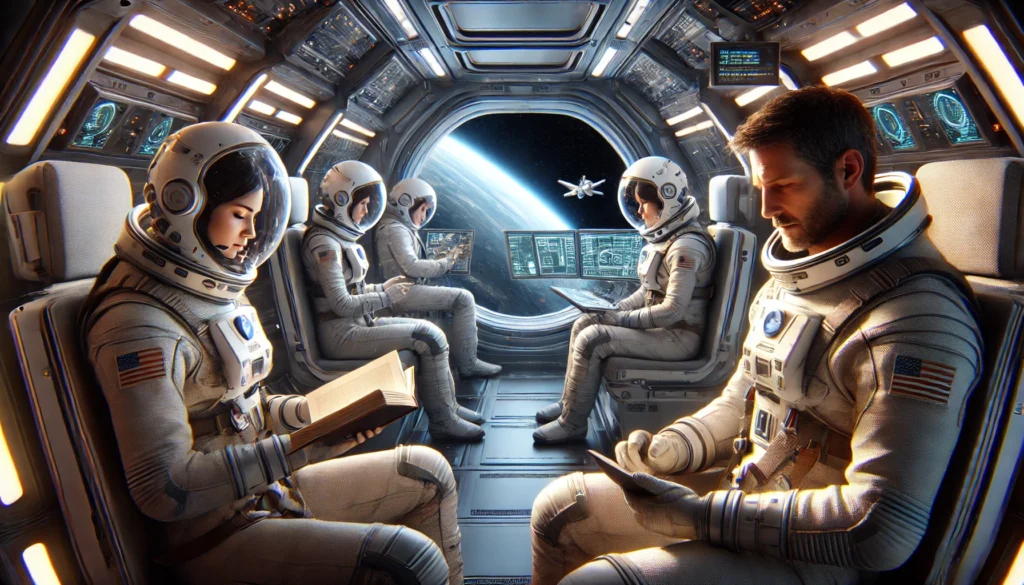
Keeping Astronauts Entertained: How to Beat Boredom in Space
Spending months—or even years—on a spacecraft means astronauts must find ways to stay engaged and entertained. With no access to live internet, they won’t be able to scroll through social media or stream their favourite shows, so space agencies are designing new ways to keep them occupied.
One option is virtual reality and gaming, which would allow astronauts to immerse themselves in the digital world, play interactive games, or even simulate Earth-like environments for relaxation. Many also bring musical instruments, with some even recording music while in orbit. Other creative outlets such as painting, writing, and photography would provide valuable brain exercise.
Since streaming isn’t possible, preloaded hard drives packed with movies, TV series, and books could be used. Some may dedicate their time to personal development—learning new skills, studying, or even writing a book.
Medical and Emergency Training
Medical training is vital for Mars astronauts. Unlike those on the International Space Station (ISS), who can receive medical help within hours, Mars crews will be entirely self-sufficient. They must be trained in first aid, basic surgery, and emergency procedures.
AI-assisted diagnostics and robotic surgery could help astronauts handle medical emergencies. Preventative health measures will also play a key role in reducing the risk of illness. As Mars exploration evolves, astronaut training will continue adapting to ensure crews can manage medical challenges far from Earth.
The Future of Astronaut Training
As human space exploration advances, astronaut training will keep evolving. Future programs may use AI-driven adaptive training, tailoring scenarios based on astronaut performance. More advanced VR and holographic simulations will make training even more immersive. Autonomous spacecraft operations will also become increasingly important, reducing the need for real-time communication with Earth.
Astronaut training has transformed massively—from the pilot-focused Apollo era to today’s advanced Mars training. As humanity ventures further into space, these advancements will be crucial for the safety and success of future explorers.
Fun Facts
🚀 The longest continuous spaceflight lasted 437 days, set by Russian cosmonaut Valeri Polyakov in 1994–1995.
🚀 Some astronauts report that space has a distinct smell, often described as burnt steak or welding fumes.
🚀 In microgravity, astronauts grow taller by up to 5 cm (2 inches) because their spines expand without Earth’s gravity compressing them.
🚀 Future Mars missions may use 3D printing to build habitats using Martian soil instead of bringing materials from Earth.
This blog was written by Laura Ash for Mission Astro.